

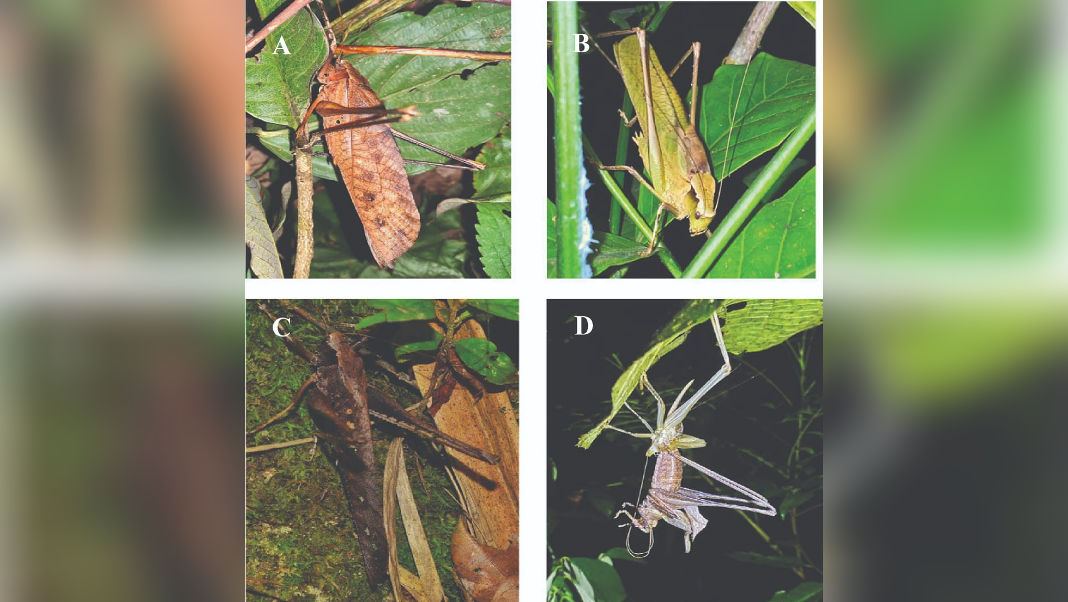

Shillong, Aug 23: A new scientific study has uncovered five distinct, coexisting call types of Mecopoda sp. katydids in the Nokrek rainforest of Meghalaya, revealing a surprising layer of biodiversity hidden in plain sight.
Katydids — often called bush crickets — are close relatives of grasshoppers and ground crickets, known for their leaf-like camouflage and diverse calls from low frequency to high frequency produced by rubbing their wings together. In general each species of bush crickets only produces one type of call throughout the lifetime.
Though morphologically near-identical, these particular species of bushcrickets exhibit striking differences in their acoustic signals, suggesting that sound — not appearance — holds the key to untangling their evolutionary story. The researchers associated with the study are from Ashoka University, Sonipat.
Published in the journal Bioacoustics, the study documents five sympatric and syntopic calling morphs: Simple Chirper, Fast Chirper, True Triller, Variable Triller, and Complex of Mecopoda . All were recorded from the same 10 sq km area in and around Nokrek National Park, part of the Indo-Burma biodiversity hotspot which also shares a boundary with the Eastern Himalayan hotspot. Nokrek consists of sub-tropical, tropical evergreen, and tropical semi evergreen forest types.
In scientific terms, “sympatric” means the different forms occur in the same broad region, while “syntopic” means they share the very same habitat. In Nokrek, this means the five call types are not just neighbors in the rainforest, but literally sing side by side in the same patches of forest — a striking case of coexistence that relies on acoustic rather than physical differences.
The calls — used by males to attract mates — differ sharply in structure, rhythm, and frequency. For instance, while the True Triller emits a continuous, uniform trill, the Variable Triller alternates between two types of syllables with dynamic amplitude patterns. The Complex caller, unique among the group, produces a three-part verse blending chirps and trills in a repeating cycle — the most elaborate structure of them all.
Morphological measurements showed almost no physical differences between the call types, making them indistinguishable to the naked eye. But genetic analysis confirmed that the call groups align with distinct evolutionary lineages, some closer to Mecopoda elongata and others to M. fallax.
“The discovery of these five calling types shows us the hidden biodiversity in the Garo Hills and is a testament to how many interesting forms evolution can produce when communities like the Garo community actively conserve forests,” says Bittu Kaveri Rajaraman of Ashoka University and one of the authors of the study.
“Mecopoda, a bushcricket genus known for its acoustic diversity, just got more intriguing. Earlier studies in the Western Ghats found five call types — our new work from the Indo-Burma region adds five more. This not only deepens the Mecopoda story in India but also uncovers a hidden chapter of cricket diversity in the Northeast, until now unknown to science” says Aarini Ghosh of Ashoka University another author of the study.
The research underscores the importance of using sound alongside physical and genetic data to reveal cryptic biodiversity in species-rich regions like Northeast India. It also points to a larger truth: India’s tropical forests may host far more diversity than currently recognized, especially among insects whose nocturnal songs remain largely unstudied.
In places like Nokrek, the forest at night may be far more diverse in voices than meets the eye.
Also Read: Meghalaya’s Bonifilia Shullai scores as India beat Bangladesh in SAFF U-17 Women’s Championship
Also Watch
Find latest news from every corner of Northeast India at hubnetwork.in, your online source for breaking news, video coverage.
Also, Follow us on-
Twitter-twitter.com/nemediahub
Youtube channel- www.youtube.com/@NortheastMediaHub2020
Instagram- www.instagram.com/ne_media_hub
Download our app from playstore – Northeast Media Hub