

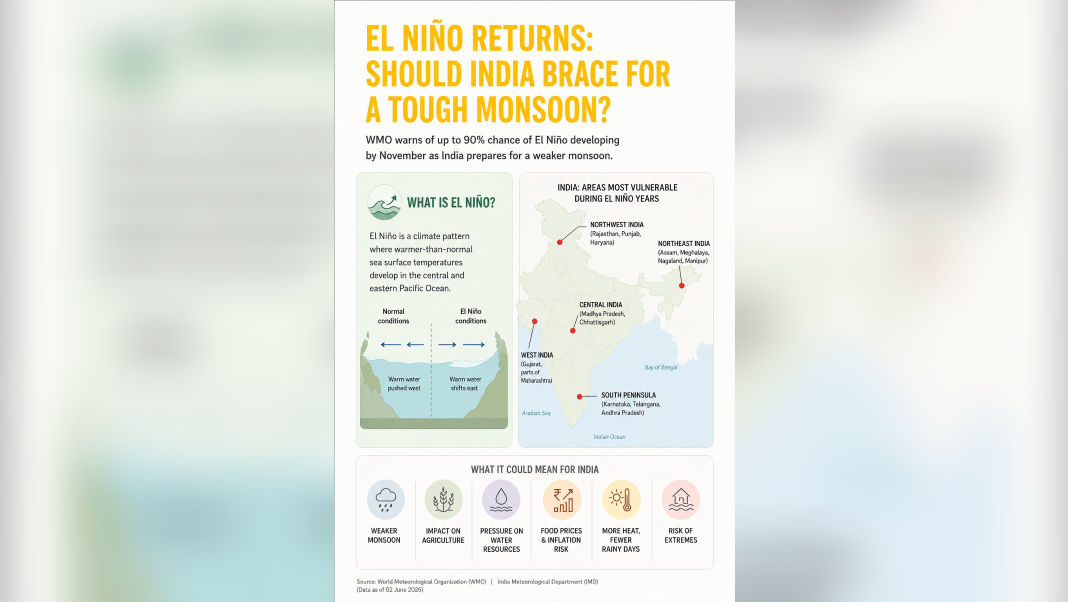

Guwahati, June 3: As residents of Assam and large parts of Northeast India and India continue to grapple with what has been described as one of the worst pre-monsoon heat waves in recent history, concerns are now resurfacing with the World Meteorological Organisation (WMO) issuing a warning that the El Niño climate phenomenon is likely to develop later this year, potentially affecting rainfall, agriculture, food prices and extreme weather across India.
The WMO has estimated that there is an 80 per cent probability of an El Niño developing between June and September, and a 90 per cent probability between December and February. This warning comes at a time when India is bracing for what is predicted to be one of its weakest monsoons in over a decade.
While El Niño occurs thousands of kilometres away in the Pacific Ocean, it has a global impact. It is caused by warmer than usual sea surface temperatures in the central and eastern Pacific, which can influence weather systems across the world by disrupting large-scale atmospheric circulation patterns.

Normally, trade winds push warm ocean waters west towards Asia and Australia, contributing to rainfall in much of South and Southeast Asia. During an El Niño, these winds weaken, pushing warm water eastward. As a result, climate patterns are altered around the world, which can lead to drought in some regions, floods in others, and considerable disruption in regional rain patterns.
India has traditionally viewed El Niño with concern owing to its historic links to weak monsoons. Several periods of drought, most notably in 1982, 1987, 2002, 2009 and 2015, coincided with El Niño events. While not every El Niño triggers drought, meteorologists widely regard it as a key climate predictor when it comes to India’s monsoon season.
The latest warning comes at a crucial juncture. The India Meteorological Department has already forecast below-normal monsoon rainfall this year, with overall seasonal rainfall estimated to be at 90 per cent of the long-period average. With almost half of India’s agricultural land dependent on rainfall, this forecast has significant implications for food production, rural livelihoods, water storage and food prices.

Scientists are also increasingly concerned that El Niño will now re-emerge in a much warmer global environment than in previous decades. Climate change is already amplifying weather extremes by increasing the intensity of heat waves, causing more extreme rainfalls and intensifying droughts.
The concerns are no longer solely about the total rainfall amount, but about its nature. In India, experts have observed a changing monsoon pattern characterized by longer dry spells, a reduction in rainy days and occasional bursts of intense rainfall. This increasing unpredictability creates new challenges in the areas of agriculture, water management and disaster preparedness.
In the case of Assam and the Northeast, the situation is more complex. While it is common to consider El Niño as a precursor to reduced rainfall across India, local weather phenomena do not always align uniformly across regions. Some areas may experience a decline in rainfall, while others may observe heavy downpours in shorter periods.

The WMO warning, therefore, goes beyond just the potential impact of a climate phenomenon in the Pacific Ocean. It also raises significant questions about the impact of a warming planet on the weather patterns on which many communities depend.
For a majority of the population of Assam, these questions seem to be felt at a very local level. Conversations around Guwahati during the unusually hot and humid summer have mostly revolved around a shared question: “If the summer is like this now, what awaits us?”.
The greater question now being asked is whether the recent prolonged period of extreme heat in Assam is merely an anomaly or a prelude to the weather uncertainty that scientists believe will accompany an El Niño event.
Also Read: High time to approach Centre as scientific mining fails in Meghalaya’s Jaintia region: Wailad
Also Watch
Find latest news from every corner of Northeast India at hubnetwork.in, your online source for breaking news, video coverage.
Also, Follow us on
Twitter-twitter.com/nemediahub
Youtube channel- www.youtube.com/@NortheastMediaHub2020
Instagram- www.instagram.com/ne_media_hub
Download our app from playstore – Northeast Media Hub

 issuing a warning that the El Niño climate phenomenon is likely to develop later this year, potentially affecting rainfall, agriculture, food prices and extreme weather across India.)