


Five years after its launch, Meghalaya’s only Human Milk Bank has helped 89 premature and critically ill babies survive, even as low awareness and equipment challenges limit its potential.
ROOPAK GOSWAMI
GUWAHATI, JUNE 14: For 89 vulnerable newborns in Meghalaya, a few millilitres of donated breast milk have made the difference between uncertainty and survival.
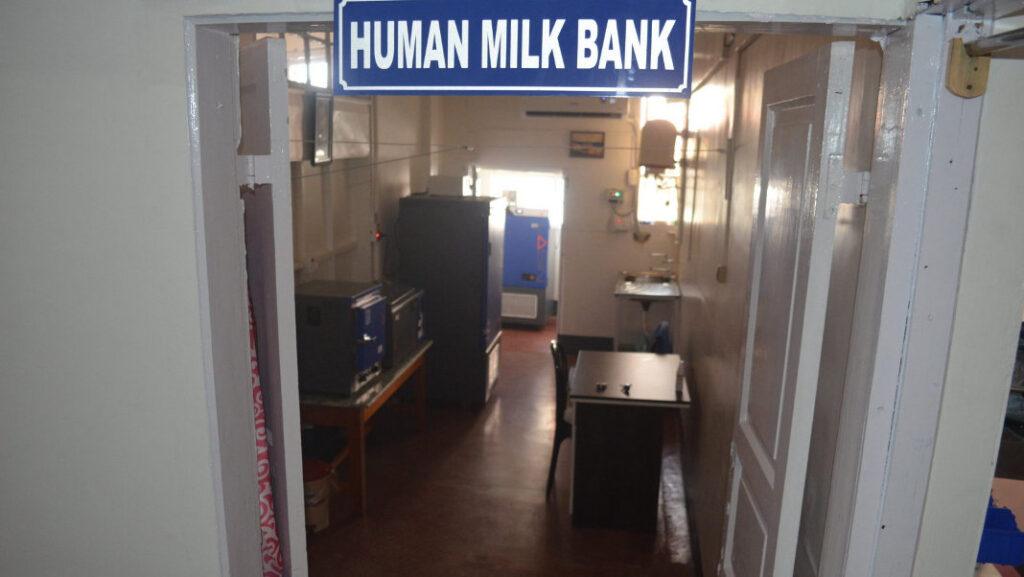
Since 2021, the state’s first Human Milk Bank at Dr H. Gordon Roberts Hospital in Shillong has quietly provided life-saving nutrition to premature and critically ill infants, even as awareness gaps and equipment constraints continue to limit its reach.
Meghalaya’s first Human Milk Bank, established at Dr H. Gordon Roberts Hospital, has emerged as a critical support system for newborns whose mothers are unable to breastfeed because of illness, childbirth complications or death. Since becoming operational in March 2021, the facility has supported 89 infants, many of them among the most medically vulnerable babies born in the state.
The Human Milk Bank, inaugurated on March 8, 2021, after being established in 2020, provides Pasteurised Donor Human Milk (PDHM) to newborns whose mothers are unable to produce sufficient breast milk due to illness, complications during childbirth, or death.
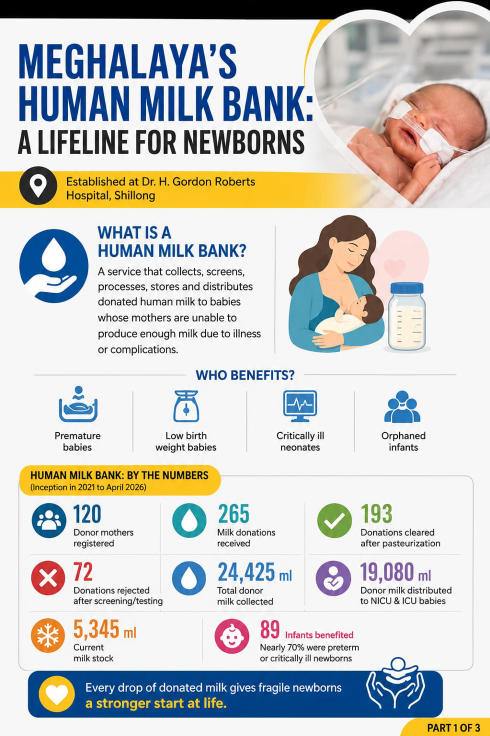
What is a Human Milk Bank? A Human Milk Bank collects, screens, pasteurises, stores and distributes donated breast milk for babies whose mothers are unable to breastfeed. Donated milk undergoes strict screening, laboratory testing and pasteurisation before being provided to vulnerable newborns, particularly premature and critically ill infants.
According to official data available till April 2026, the Milk Bank has registered 120 donor mothers and collected 265 donations. Of these, 193 donations were successfully sterilised and cleared for use after pasteurisation. The facility has received a total of 24,425 mL of donor milk and distributed 19,080 mL to infants admitted to the Neonatal Intensive Care Unit (NICU) and Intensive Care Unit (ICU). It currently maintains a stock of 5,345 mL.
Hospital authorities said nearly 70 per cent of the 89 infants who received donor milk were preterm or critically ill newborns. The remaining beneficiaries were babies whose mothers had died immediately after childbirth or were themselves critically ill and admitted to adult intensive care units.
Doctors say donor human milk has played a crucial role in reducing the risk of infections among vulnerable newborns, improving immunity, lowering the risk of Necrotising Enterocolitis (NEC) — a potentially fatal intestinal disease affecting premature babies — and supporting faster recovery.
While no formal study has been conducted to assess the impact of the Milk Bank on neonatal infection rates or NEC cases, clinicians report significant improvements in outcomes among high-risk newborns.
One of the most remarkable success stories cited by the hospital is that of a baby girl born at just 24 weeks of gestation and weighing only 640 grams. She received pasteurised donor human milk throughout her stay in the NICU and recently celebrated her third birthday.
“Preterm babies benefit the most from donor milk. The smallest recipient at our facility weighed only 640 grams at birth. Today, she is thriving,” a hospital official said.
However, the Milk Bank’s achievements have come despite persistent operational challenges. Hospital authorities identified limited public awareness about human milk donation as one of the biggest obstacles.
Many mothers continue to harbour misconceptions, including fears that donating milk will leave less milk for their own child, concerns over the safety and use of donated milk, and cultural reservations about babies receiving milk from another mother.
“There is also an inferiority complex among some mothers who feel their milk may not be good enough for donation,” officials said.
Other misconceptions include beliefs that milk donation is painful, time-consuming or carries a risk of transmitting disease.
Hospital staff routinely counsel mothers that rigorous donor screening, pasteurisation and laboratory testing ensure the safety of donated milk and that donations are accepted only after a mother’s own baby has been adequately fed.
Officials said the relatively small donor base of 120 mothers over five years reflects the hospital’s strict safety protocols. At present, donations are accepted only from mothers admitted to the hospital, particularly those whose babies are in the NICU and temporarily unable to receive oral feeds.
The hospital does not collect milk from external donors without complete medical histories and laboratory investigations, citing safety concerns.
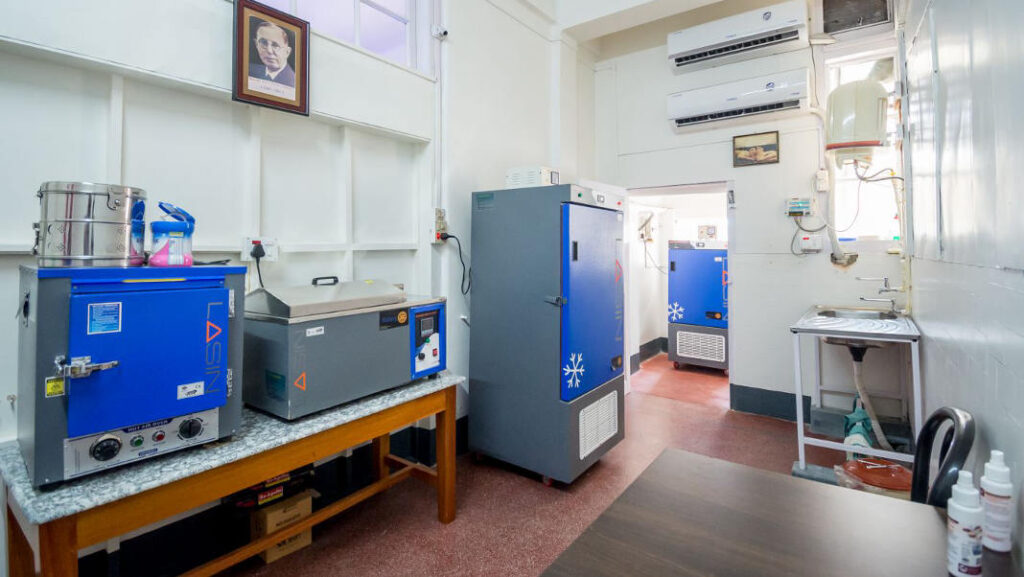
Equipment-related challenges have also affected operations. The Water Bath Shaker used during the pasteurisation process is currently functioning only once a day because of technical issues, limiting the volume of donor milk that can be processed. Hospital authorities said the facility has previously faced prolonged periods when pasteurisation equipment became non-functional, requiring the procurement of a replacement pasteuriser last year after the older unit was condemned.
Officials said that any future breakdown in the pasteurisation system could directly affect the availability of donor milk for critically ill infants.
“If the pasteuriser stops functioning, it will definitely affect our ability to provide donor milk to babies who need it most. Government support in ensuring backup equipment is available will be critical,” hospital officials said.
To encourage more mothers to donate, the hospital has intensified counselling efforts among lactating mothers in the NICU and other wards. Staff nurses provide one-on-one guidance on the benefits of breastfeeding and explain how surplus milk can help save the lives of vulnerable newborns.
Hospital authorities stressed that all donations are entirely voluntary and that mothers are never pressured to participate. Initiatial equipments were funded by Rotary Club Shillong.
As part of World Human Milk Donation Day observances, the hospital organised a felicitation programme for donor mothers on May 19, recognising their contribution and encouraging wider public participation.
The hospital is also developing posters, flyers and educational materials to expand awareness across the state.
Despite the progress made over the past five years, officials believe Meghalaya’s human milk donation movement remains at an early stage. They attribute limited awareness to inadequate resources for public outreach, persistent social misconceptions and the absence of large-scale sensitisation campaigns.
For now, Meghalaya’s only Human Milk Bank continues to depend on a small network of donor mothers, dedicated healthcare workers and ageing equipment. Yet every bottle of donated milk represents something larger: a community effort to give the state’s most vulnerable newborns a chance not just to survive, but to thrive.
Also Read: Four die of Japanese Encephalitis at GMCH as study warns Assam remains India’s worst-hit state
Also Watch
Find latest news from every corner of Northeast India at hubnetwork.in, your online source for breaking news, video coverage.
Also, Follow us on
Twitter-twitter.com/nemediahub
Youtube channel- www.youtube.com/@NortheastMediaHub2020
Instagram- www.instagram.com/ne_media_hub
Download our app from playstore – Northeast Media Hub