

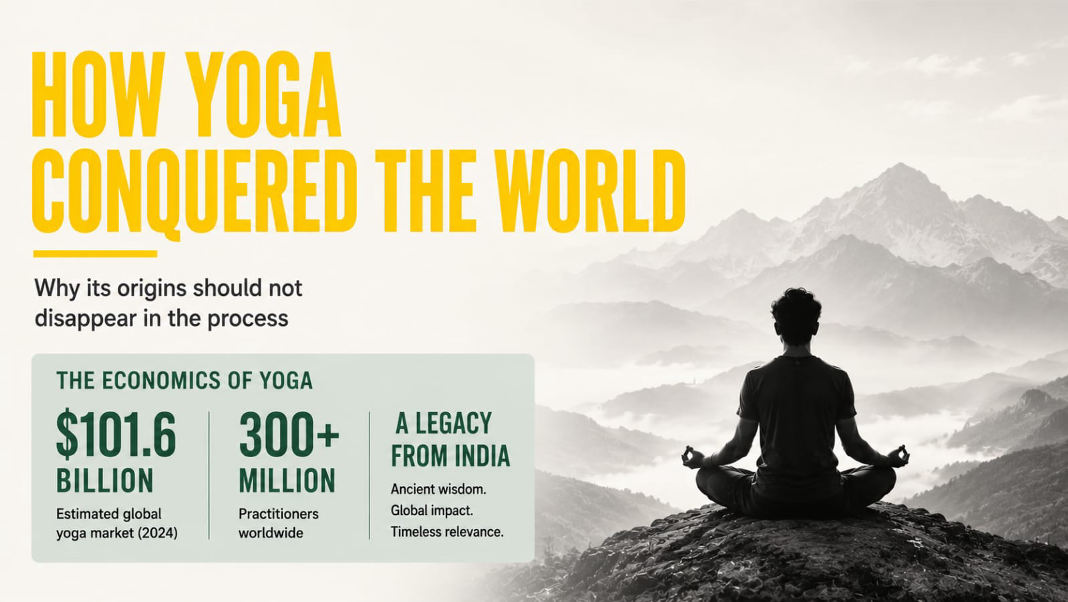

How yoga conquered the world—and why its origins should not disappear in the process
There is a curious irony at the heart of yoga’s extraordinary global success.
Today, millions of people across the world begin their mornings with yoga. Doctors recommend it, athletes incorporate it into their training routines, universities study it, corporations include it in employee wellness programmes, and social media influencers have built entire careers around teaching it. Yoga retreats have become a global industry, while wellness brands package and market it as a pathway to better health, reduced stress and improved quality of life.
Yet for all its popularity, a surprisingly uncomfortable question lingers beneath the surface: where exactly did yoga come from?
It is a question that should have an obvious answer. And yet, in many discussions about yoga, the civilisation that produced it often appears only as a passing reference, if at all. The practice is enthusiastically embraced; the roots are treated as optional. Yoga is celebrated, commercialised, researched and reinvented, but the philosophical and cultural traditions that nurtured it are increasingly pushed to the margins of the conversation.
This is not an argument against yoga’s globalisation. Far from it. The journey of yoga from ancient India to every corner of the world is one of humanity’s great cultural success stories. The fact that people of different nationalities, faiths and backgrounds have found meaning in yoga is a testament to its universality and enduring relevance.
The problem is not that yoga travelled.
The problem is that, somewhere along the journey, memory began to fade.
The story of yoga did not begin in a modern fitness studio, a wellness retreat or a corporate boardroom. Its roots lie deep within India’s spiritual and philosophical traditions. References to yogic ideas can be found in the Vedas and the Upanishads, but perhaps nowhere is the concept explored more profoundly than in the Bhagavad Gita. Long before yoga mats, branded activewear and social media tutorials existed, the Gita described yoga not as a fitness regime but as a path towards self-mastery, discipline, self-realisation and ultimately liberation.
This distinction is important because the yoga of the Bhagavad Gita was never primarily concerned with physical appearance. Lord Krishna’s teachings on Karma Yoga, Bhakti Yoga and Jnana Yoga were not instructions on how to become more flexible or physically attractive. They were explorations of how human beings might align action, devotion and knowledge with a deeper spiritual purpose.
At its heart, yoga emerged from a profound inquiry into the nature of existence itself. The great yogic traditions asked questions that remain relevant even today: Who am I beyond my social roles and identities? What is consciousness? Why does the human mind suffer? What does it mean to live in harmony with oneself and the world?
Underlying these questions was a powerful idea: that human beings are more than their bodies, more than their thoughts and more than their individual personalities. Concepts such as Atman and Brahman expressed the belief that individual consciousness is connected to a larger reality. Whether one accepts these metaphysical ideas or not, it is impossible to understand yoga fully without acknowledging the philosophical framework from which it emerged.
This is why reducing yoga to a collection of stretches misses the point entirely.
Traditional yogic thought certainly valued physical health, strength and flexibility. But these were never viewed as ends in themselves. The body mattered because it was the vehicle through which awareness could be cultivated. Good health was important because it supported a disciplined and purposeful life. The physical benefits of yoga were recognised, but they were considered by-products of a deeper journey rather than the destination itself.
Modern culture, however, often tells a very different story.
In many parts of the world, yoga is now marketed primarily as a lifestyle product. Social media platforms are saturated with promises of flatter stomachs, toned physiques and dramatic body transformations. Ancient disciplines concerned with self-realisation are frequently repackaged as quick routes to physical perfection. A tradition that once sought liberation from attachment has, in some spaces, become another product competing for attention in an increasingly commercialised wellness marketplace.
And yet, despite this commercialisation, yoga continues to demonstrate its value in ways that even its most sceptical critics can no longer ignore.
Modern medicine has increasingly begun to recognise what practitioners of yoga have understood for centuries. Research continues to explore yoga’s role in improving flexibility, balance, mobility, rehabilitation outcomes, stress management, chronic pain and overall well-being. Hospitals, physiotherapists, psychologists and sports scientists now engage seriously with practices that were once casually dismissed as mystical or unscientific.
What is remarkable is that yoga itself did not fundamentally change.
What changed was the willingness of modern institutions to study it.
In many ways, this reveals another uncomfortable truth—not about the West, but about India itself.
For decades, large sections of India’s educated classes treated yoga as something old-fashioned, spiritual or vaguely unscientific. It was often associated with ascetics, saints and elderly relatives rather than viewed as a sophisticated knowledge system worthy of serious study. At the very moment many Indians were distancing themselves from yoga, however, thousands of foreigners were travelling to Mysore to learn from some of the greatest yoga masters of the modern era.
Students from Europe, America and Australia travelled thousands of kilometres to study under teachers such as B.K.S. Iyengar and K. Pattabhi Jois. Mysore became a global pilgrimage centre for serious practitioners. What many Indians regarded as ordinary, foreigners recognised as extraordinary.
The irony is difficult to miss.
While India often questioned the value of its own inheritance, the rest of the world was busy discovering it.
As scientific research expanded and the wellness industry exploded, yoga evolved into a multi-billion-dollar global enterprise. Universities established programmes. Research journals published findings. Health professionals began recommending it. Suddenly, a practice that had long been dismissed in some circles was being validated by the very institutions many Indians trusted most.
Perhaps the most uncomfortable lesson in yoga’s journey is how often India has needed external validation before recognising the worth of its own civilisational inheritance.
Yet the story becomes even more complicated when one examines how yoga is remembered—or forgotten—once it becomes successful.
For decades, sections of the Western world viewed Indian traditions through a mixture of scepticism, exotic fascination and, at times, outright condescension. Yoga, meditation and other Indian knowledge systems were frequently treated as mystical curiosities rather than serious intellectual contributions. Today, many of those same traditions underpin thriving global industries worth billions of dollars.
The issue is not that the world embraced these ideas. It should have.
The issue is that acceptance often arrived only after the ideas had been detached from the civilisation that produced them.
When ancient concepts are repackaged, renamed and commercialised while their origins become increasingly invisible, a legitimate question arises: are we witnessing cultural exchange, or a form of selective remembering?
That question becomes especially relevant when one considers how many practitioners know Downward Dog but have never heard the name Adho Mukha Svanasana, recognise Cobra Pose but not Bhujangasana, or practise techniques whose Sanskrit names and philosophical foundations have quietly disappeared from view.
Translations are useful. Erasure is not. And perhaps that is the central question facing yoga today.
Can the world continue embracing yoga while also acknowledging, honestly and unapologetically, where it came from?
Also Read: Tourist route to Dawki cut off as landslide forces closure of Shillong-Dawki highway
Also awatch
Find latest news from every corner of Northeast India at hubnetwork.in, your online source for breaking news, video coverage.
Also, Follow us on
Twitter-twitter.com/nemediahub
Youtube channel- www.youtube.com/@NortheastMediaHub2020
Instagram- www.instagram.com/ne_media_hub
Download our app from playstore – Northeast Media Hub