

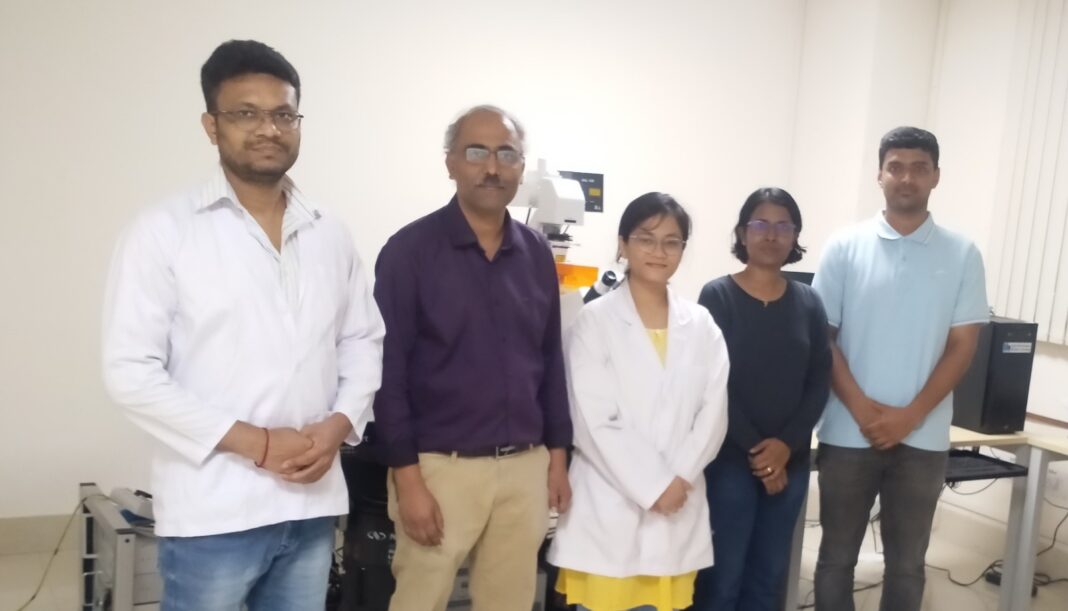

Guwahati, May 19: Researchers at the Indian Institute of Technology (IIT) Guwahati have created an easy-to-use fluorescent sensor that can detect dangerous cyanide contamination in water and even inside human cells using just a UV light source. The team, led by Prof. G. Krishnamoorthy from the Department of Chemistry, developed this sensor to help prevent cyanide poisoning, which can occur through contaminated water or industrial exposure.
Cyanide is a highly toxic chemical used in industries like gold mining, metal cleaning, and plastic manufacturing. If not properly handled, it can leak into water sources, posing serious health risks. Even small amounts can interfere with the body’s ability to use oxygen, leading to severe illness or death.
The sensor is based on a compound called DHP (2-(4′-diethylamino-2′-hydroxyphenyl)-1H-imidazo-[4,5-b]pyridine). Under UV light, DHP normally emits a faint blue glow. However, when cyanide is present, the sensor undergoes a chemical change that causes it to emit a bright cyan light. This “turn-on” response makes it easy to detect cyanide visually, reducing the chances of missing contamination.

The sensor is highly sensitive, capable of detecting cyanide concentrations as low as 0.02 μM in certain conditions, which is well below the World Health Organisation’s safe limit of 1.9 μM in drinking water.
The IIT Guwahati team tested the sensor in various real-world scenarios. It successfully detected cyanide in river and tap water samples with an accuracy of 75–93%. The sensor can also be applied to paper strips for portable testing, making it useful for fieldwork. Additionally, it has been used to detect cyanide inside live human cells, indicating potential applications in medical diagnostics and forensic investigations.
Speaking about the developed technology, Prof. Krishnamoorthy, an expert in Molecular Fluorescence & Spectroscopy, said, “What sets this sensor apart is its versatility. The sensor works not only in lab solutions but also in river and tap water samples, with an accuracy of 75–93%. It can be embedded into paper strips for portable testing and is effective in live cell imaging. In fact, the sensor was used to detect cyanide inside biological cells, showing promise for applications in environmental and forensic investigations.”
Beyond detecting cyanide, the sensor’s design allows it to function like a basic logic gate, a fundamental component in digital electronics. This feature opens up possibilities for developing smart devices that can monitor harmful chemicals in real-time.
The research, published in the journal Spectrochimica Acta Part A: Molecular and Biomolecular Spectroscopy, was a collaborative effort involving Prof. Bithiah Grace Jaganathan from the Department of Bioscience and Bioengineering, and research scholars Ms. Mongoli Brahma, Mr. Arup Das Kanungo, Ms. Minati Das, and Mr. Sam P. Mathew.
The team is now working on developing a simple testing kit that can detect various harmful substances, aiming to make environmental and health monitoring more accessible and affordable.

Also Read: Kaziranga sees record tourist surge: What’s drawing people to Assam’s iconic wildlife haven
Watch
Find latest news from every corner of Northeast India at hubnetwork.in, your online source for breaking news, video coverage.
Also, Follow us on-
Twitter-twitter.com/nemediahub
Youtube channel- www.youtube.com/@NortheastMediaHub2020
Instagram- www.instagram.com/ne_media_hub
Download our app from playstore – Northeast Media Hub