

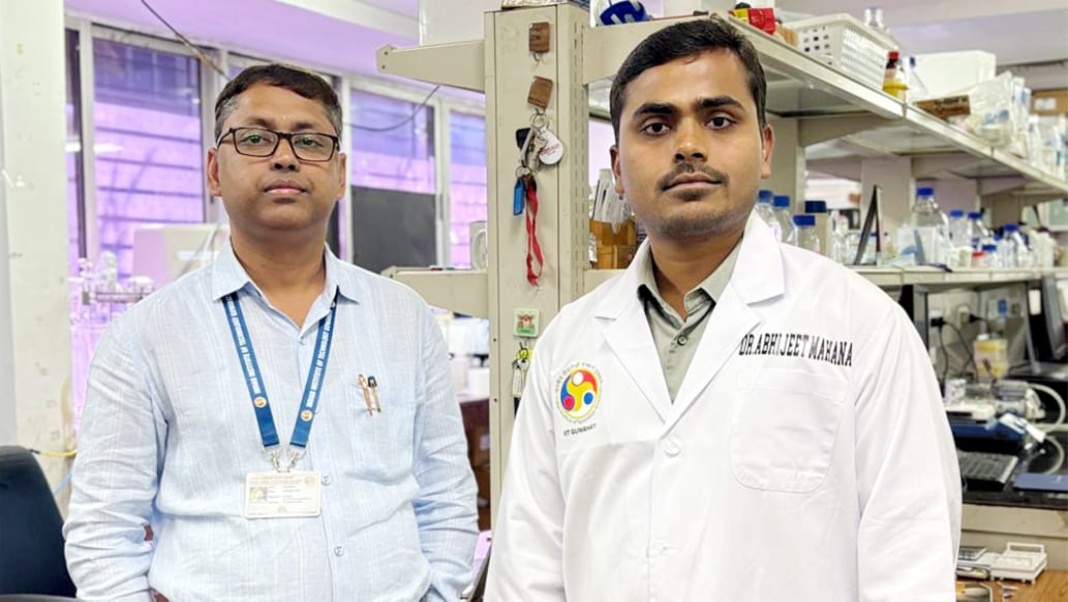

Guwahati, July 8: Researchers at the Indian Institute of Technology (IIT) Guwahati have developed a biological material derived from blue-green algae that can remove up to 66.2 per cent of toxic lead from contaminated water, offering a promising eco-friendly alternative to conventional water treatment technologies.
The findings, published in the Journal of Environmental Chemical Engineering, come amid growing concerns over lead contamination in India’s drinking water.
According to a 2020 UNICEF-Pure Earth report, more than 275 million children in India have blood lead levels above safe limits, while the Central Ground Water Board (CGWB) has reported that 20-30 per cent of groundwater samples tested in major Indian cities exceeded the World Health Organization’s recommended limits.

The research team, led by Prof. Debasish Das of IIT Guwahati’s Department of Biosciences and Bioengineering, found that exopolysaccharides (EPS)—a sticky, sugar-rich substance naturally produced by blue-green algae—can effectively bind and remove lead from contaminated water.
Unlike conventional treatment methods such as chemical precipitation, membrane filtration and ion exchange, which are often costly, energy-intensive and generate secondary pollutants, the algae-based approach offers a renewable and environmentally friendly alternative.
“In our study, EPS removed 66.2 per cent of lead, one of the most toxic heavy metals, from contaminated water,” Prof. Das said. He added that the same biological material also has the potential to enrich soil by fixing nitrogen and could serve as a natural biofertiliser.
Using advanced analytical techniques, the researchers found that naturally occurring chemical groups within the EPS bind lead particles, while the algae also alter their chemical composition in response to lead exposure, enhancing their ability to capture the metal.
The study was co-authored by Prof. Tapas Kumar Mandal of the Department of Chemical Engineering and Dr. Abhijeet Mahana, a postdoctoral fellow at IIT Guwahati.
The researchers now plan to test the material on real industrial wastewater containing multiple toxic metals, evaluate whether the biosorbent can be reused, and develop a scalable system for continuous water treatment.
The team emphasised that the technology is currently at the laboratory stage and will require further validation before it can be deployed for commercial or large-scale water purification.
Also Read: Nagaland launches digital agriculture platform as farmers battle post-harvest losses
Also Watch
Find latest news from every corner of Northeast India at hubnetwork.in, your online source for breaking news, video coverage.
Also, Follow us on
Twitter-twitter.com/nemediahub
Youtube channel- www.youtube.com/@NortheastMediaHub2020
Instagram- www.instagram.com/ne_media_hub
Download our app from playstore – Northeast Media Hub

 Guwahati have developed a biological material derived from blue-green algae that can remove up to 66.2 per cent of toxic lead from contaminated water, offering a promising eco-friendly alternative to conventional water treatment technologies.)