

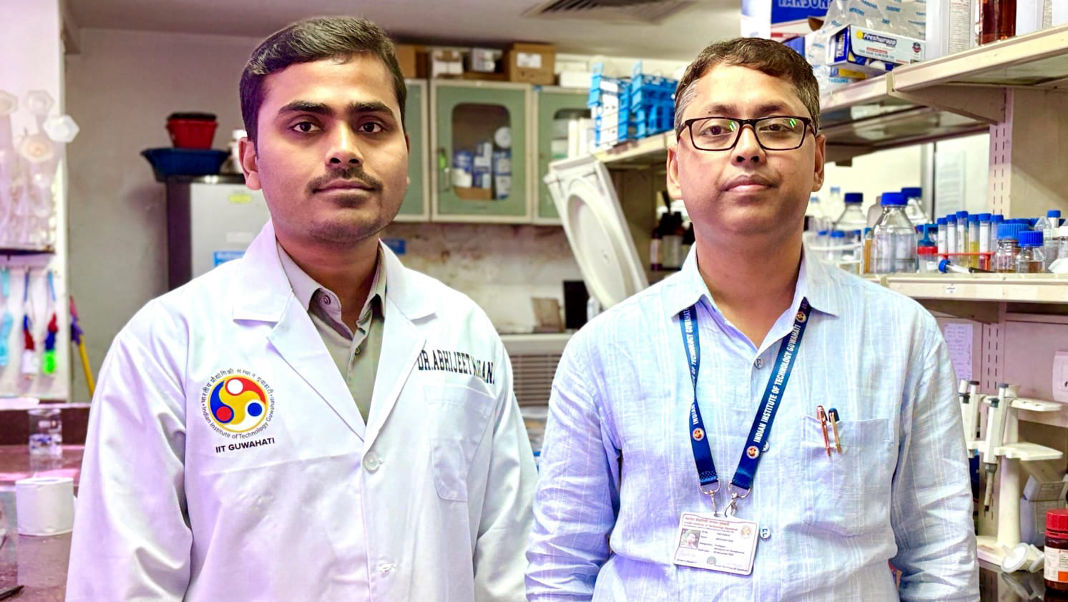

Guwahati, Nov 21: In a breakthrough for clean-water solutions, researchers at the Indian Institute of Technology (IIT) Guwahati have developed a natural, low-cost method to remove toxic lead from contaminated water using cyanobacteria — tiny photosynthetic microorganisms commonly found in nature.
The study, published in the Journal of Hazardous Materials, was led by Prof. Debasish Das (Department of Biosciences and Bioengineering) with Dr Abhijeet Mahana and Prof. Tapas K. Mandal (Department of Chemical Engineering).
Lead pollution is among the world’s most dangerous environmental threats, affecting more than 800 million children globally, including 275 million in India. It enters water from industrial waste, agricultural runoff, and ageing pipelines, and once present, it can persist for decades — causing severe neurological, kidney, cardiovascular, and developmental damage.

Current treatment methods often rely on costly chemicals or synthetic adsorbents that can create secondary pollution. IIT Guwahati’s team turned to bioremediation, a natural cleaning process in which microorganisms break down harmful contaminants.
For the study, the researchers used a light-dependent cyanobacterial species, Phormidium corium NRMC-50, and examined which parts of the organism were most effective at binding lead. They found that exopolysaccharides (EPS) — a natural compound produced by the cyanobacteria — could remove up to 92.5% of lead from contaminated water.
“This method requires very little energy and can be scaled up without complex infrastructure,” said Prof. Das. “Our preliminary estimates show it could cut treatment costs by 40–60% compared to conventional techniques, while offering equal or better performance. Its eco-friendly nature makes it suitable for industries and municipalities looking for affordable solutions.”
The researchers also highlighted that cyanobacteria can absorb multiple pollutants — including pesticides, dyes, and industrial chemicals — and the trapped metals can later be recovered to produce useful materials such as biochar, bioplastics, and biofuels.
Because these microorganisms are self-replicating and need only sunlight, carbon dioxide, and minimal nutrients, the method offers a sustainable, accessible alternative to synthetic materials currently used worldwide.
The team’s next step is to scale up from laboratory experiments to a pilot treatment system, testing the approach in real wastewater environments.
Also Read: Rediscovering Syiar Markasa: Meghalaya’s indigenous chicken enters scientific spotlight
Also Watch
Find latest news from every corner of Northeast India at hubnetwork.in, your online source for breaking news, video coverage.
Also, Follow us on-
Twitter-twitter.com/nemediahub
Youtube channel- www.youtube.com/@NortheastMediaHub2020
Instagram- www.instagram.com/ne_media_hub
Download our app from playstore – Northeast Media Hub

 Guwahati have developed a natural, low-cost method to remove toxic lead from contaminated water using cyanobacteria — tiny photosynthetic microorganisms commonly found in nature.)