


Kaziranga, June 5: For decades, Kaziranga has been known as the land of the one-horned rhinoceros. Yet, for much of its history, the park’s significance as a haven for birds remained overshadowed by its larger and more celebrated residents.
A new survey is now bringing that hidden story into focus.
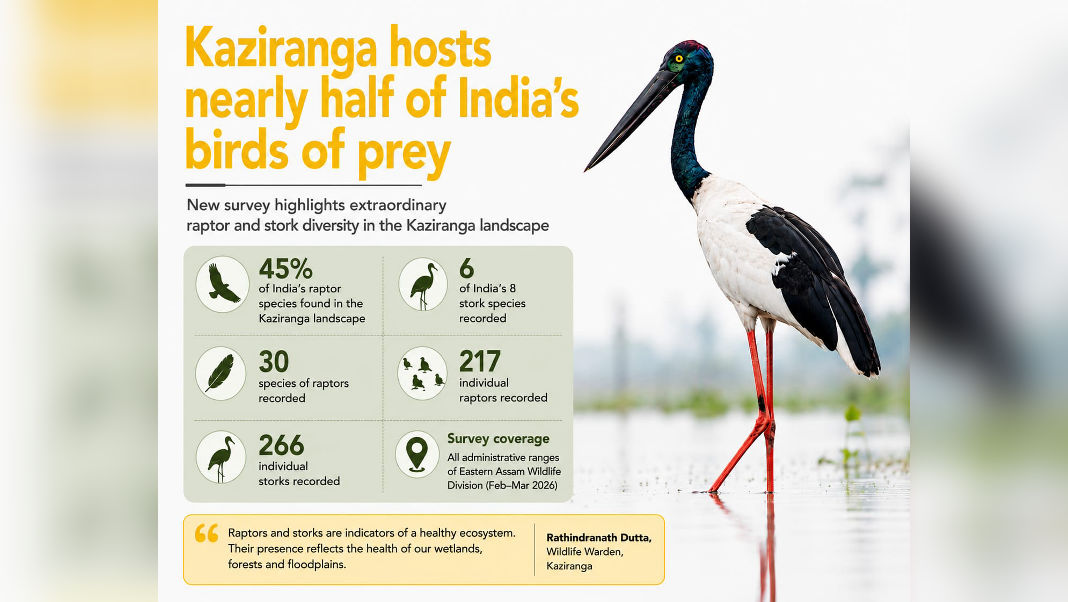
A comprehensive assessment of storks and raptors conducted by the Kaziranga Tiger Reserve Authority in collaboration with research scholars from Assam universities has revealed that the Kaziranga landscape supports nearly 45 per cent of India’s recorded raptor species, making it one of the country’s most important strongholds for birds of prey.
The survey, carried out between February and March across all administrative ranges of the Eastern Assam Wildlife Division, documented 30 species of raptors represented by 217 individual birds, along with six species of storks represented by 266 individual birds.

What makes the findings remarkable is their national significance.
India is home to 112 recorded species of raptors. While the survey documented 30 species during the study period, the broader Kaziranga landscape is known to support nearly 50 species of birds of prey. In other words, almost half of India’s raptor diversity is concentrated within a single conservation landscape.
The survey also recorded six of India’s eight stork species, further underscoring the ecological importance of the Brahmaputra floodplains.
There are compelling reasons why this corner of Assam has become such a refuge.
Situated at the meeting point of extensive wetlands, seasonal floodplains, tall riverine forests and the Himalayan foothills, Kaziranga offers an extraordinary range of habitats. The mosaic of grasslands, water bodies and nesting sites provides ideal conditions for resident birds as well as migratory species that travel thousands of kilometres across Asia.
As a result, the landscape has emerged as a sanctuary for some of the continent’s most threatened birds.
Among the raptors recorded were the Pallas’s Fish Eagle, Greater Spotted Eagle, Grey-headed Fish Eagle, Steppe Eagle, Slender-billed Vulture, Red-headed Vulture, Brown Fish Owl and Dusky Eagle-Owl. The storks included the Greater Adjutant, Lesser Adjutant, Black-necked Stork, Black Stork and Asian Openbill.
Many of these species are experiencing declines across their global ranges, making the wetlands and floodplains of Kaziranga increasingly important for their survival.
Particularly noteworthy is the Pallas’s Fish Eagle, an endangered species whose numbers have declined across much of Asia.
According to the survey, Kaziranga supports the highest known concentration of nesting sites for the species in India. Earlier studies by the Wildlife Institute of India documented at least ten active nests within the landscape, suggesting that the park may represent one of the most significant breeding grounds for the species anywhere in the world.
The story becomes even more fascinating when viewed through the lens of migration.
Researchers from the Wildlife Science and Conservation Center of Mongolia previously tagged a Pallas’s Fish Eagle named Ider at Buuntsagaan Lake in Central Western Mongolia. The bird has since returned to Kaziranga year after year, travelling thousands of kilometres across international boundaries to breed, highlighting the park’s role in a vast ecological network that stretches from Central Asia to the Brahmaputra Valley.
The survey also revealed important variations across divisions.
Kaziranga National Park recorded the highest diversity, with 21 species of raptors and five species of storks, followed closely by Biswanath Wildlife Division, which recorded 20 species of raptors and six species of storks. Nagaon Wildlife Division recorded 14 species of raptors and five species of storks.
Among the storks, the Asian Openbill emerged as the most abundant species with 92 sightings, while the critically endangered Greater Adjutant was among the rarest, with only three individuals recorded.
Among the raptors, the Himalayan Griffon was the most commonly sighted species with 69 records. The Booted Eagle and White-tailed Eagle were the rarest sightings, with just one individual each documented during the survey.
Wildlife authorities say the findings further strengthen Kaziranga’s standing as one of India’s most important conservation landscapes.
“Raptors and storks occupy the top levels of the food chain across wetland, floodplain and forest ecosystems. Their presence and population trends are strong indicators of ecosystem health,” said Kaziranga Wildlife Warden Rathindranath Dutta.
The survey has also highlighted key conservation priorities, including protection of nesting sites, preservation of floodplain habitats, mitigation of power-line electrocution risks, continued telemetry studies and stronger international cooperation for migratory species.
The findings reveal a side of Kaziranga that is often overshadowed by its world-famous rhinos.
If the grasslands below helped make Kaziranga a global conservation icon, the skies above are telling an equally extraordinary story — one in which nearly half of India’s raptor species share a single landscape in the heart of the Brahmaputra floodplains.
Also Read: Arunachal woman killed as DEMU train drags SUV 400 metres at Assam crossing
Also Watch
Find latest news from every corner of Northeast India at hubnetwork.in, your online source for breaking news, video coverage.
Also, Follow us on
Twitter-twitter.com/nemediahub
Youtube channel- www.youtube.com/@NortheastMediaHub2020
Instagram- www.instagram.com/ne_media_hub
Download our app from playstore – Northeast Media Hub