


Shillong, June 6: In a region where border fencing projects routinely get stuck over terrain, legal challenges, land ownership and diplomatic complexities, Meghalaya has achieved remarkable success on the border it shares with Bangladesh.
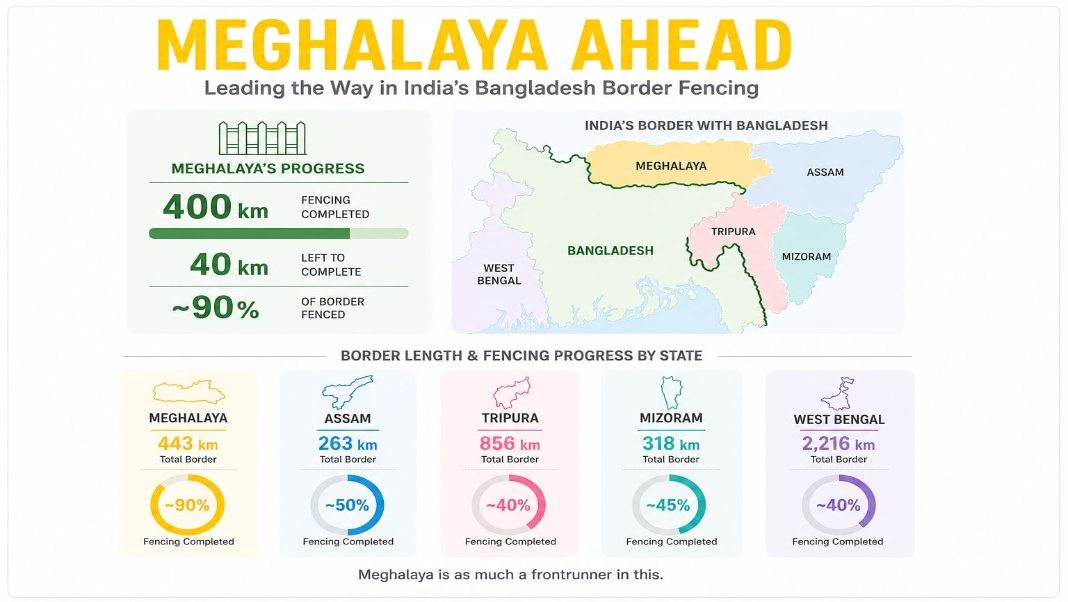
The state shares a 443-km international border with its eastern neighbour. These stretches pass through East Khasi Hills, West Khasi Hills, South West Khasi Hills, East Jaintia Hills, West Jaintia Hills, South Garo Hills and South West Garo Hills. Nearly 400 km of this border has already been fenced, leaving just 40-45 km pending.
That means Meghalaya is now within touching distance of completing one of the Northeast’s most significant border infrastructure projects.
Chief Minister Conrad K. Sangma recently underscored the scale of the achievement, stating that nearly 400 km of fencing has already been completed and that only about 40-45 km remains. Significantly, he noted that the unfinished portion is no longer being held up by construction challenges. According to the Chief Minister, most of the delay is linked to local issues and objections in the remaining stretches.
In comparison to other border-fencing projects across India, Meghalaya’s initiative is nearly 90 per cent complete. Considering that the Bangladesh border is India’s longest international boundary, spanning 4,096 km, Meghalaya’s position stands out.
West Bengal accounts for 2,217 km of the border, Tripura 856 km, Meghalaya 443 km, Mizoram 318 km and Assam 262 km. While every state faces its own set of challenges, Meghalaya is among the very few that can now see the finish line.
Geography and governance have worked together rather than against each other.
While large parts of the Bangladesh border in West Bengal run through densely populated plains, Meghalaya’s frontier cuts across steep escarpments, dense forests, isolated valleys and sparsely connected settlements.
The terrain was never expected to make this easy. That is precisely why the progress stands out.
The state government, the BSF and the Union Home Ministry have steadily pushed the project forward even as several other border stretches across the country faced delays.
Records available with the BSF indicate that border fencing has long been a high priority in Meghalaya. The state continues to face challenges relating to illegal migration, cattle smuggling, narcotics trafficking and infiltration.
The numbers tell their own story.
In just three months, BSF personnel apprehended 116 Bangladeshi nationals, seized 622 cattle valued at more than Rs 6 crore and recovered contraband worth over Rs 1.3 crore. Unfenced stretches have often been identified as vulnerable corridors for such illegal movement.

Security concerns have therefore translated into sustained political will.
Successive governments and security agencies have treated border fencing as a long-term strategic priority rather than a seasonal announcement. Sangma has repeatedly pushed for completion of the remaining stretches, while surveillance, patrols and border infrastructure have continued to be strengthened.
The contrast with neighbouring states is revealing.
In West Bengal, border fencing has encountered land transfer and acquisition issues. Earlier this month, the state government handed over 32 acres of land to the BSF to facilitate work on pending stretches.
Tripura faces a different challenge altogether. With an 856-km border, nearly double that of Meghalaya, the scale of construction and maintenance itself is enormous.
In Mizoram, difficult terrain and remote locations continue to complicate infrastructure projects.
Meghalaya’s achievement, therefore, is not merely about kilometres fenced.
It is about steady progress in a place where geography offered few shortcuts.
The final 40 kilometres
Ironically, the final stretch has become more about people than infrastructure.
Sangma’s observation perhaps best captures the challenge ahead. The remaining 40-45 km is not delayed because engineers are unable to build it or because the terrain is proving too difficult. Instead, the unfinished stretches are largely tied to local issues and objections.
Land acquisition disputes, court cases and community concerns, particularly in parts of West Jaintia Hills, account for much of the delay. The issues involve private land, village access routes and long-standing local sentiments.
The mountains have largely been crossed.The harder task now lies in building consensus.
BSF officials acknowledge that disputes, local objections and clearance procedures in sensitive zero-line areas slowed progress in the past. Many of those hurdles have since been resolved, helping Meghalaya move from roughly 70 per cent fencing a few years ago to nearly 90 per cent today.
The remaining stretch, however, will require careful political and administrative handling.
If and when those final kilometres are completed, Meghalaya will not merely add another section of fencing to the map. It will demonstrate how sustained coordination between the state government, local communities and security agencies helped overcome some of the most formidable challenges posed not just by geography, but by the complex realities of life along an international border.
Also Read: Meghalaya pushes for honey testing labs, bee corridors to boost rural economy
Also Watch
Find latest news from every corner of Northeast India at hubnetwork.in, your online source for breaking news, video coverage.
Also, Follow us on
Twitter-twitter.com/nemediahub
Youtube channel- www.youtube.com/@NortheastMediaHub2020
Instagram- www.instagram.com/ne_media_hub
Download our app from playstore – Northeast Media Hub