



Guwahati, Sept 15: A new scientific study has revealed that one of Meghalaya’s most revered sacred forests—the Law Kyntang Ryngkew Swer Sacred Grove in East Khasi Hills—harbours significant carbon reserves, making it not just a spiritual sanctuary but also a natural climate ally.
Sacred groves are forest fragments traditionally preserved by indigenous communities for cultural and spiritual reasons. Found across India and parts of Asia, and Africa, they can range from less than a hectare to several hundred hectares and often serve as the last bastions of primary forest in otherwise degraded landscapes.
Meghalaya, often called the “abode of clouds,” is especially rich in forest biodiversity, with around 42% of its geographical area under forest cover. Its unique physiography, high rainfall, and altitudinal variation support diverse forest types—from tropical evergreen to subtropical pine forests. While earlier research on the state’s sacred groves has focused on floristic diversity, ethnobotany, and conservation, few studies have systematically quantified their biomass and carbon storage potential using standardised field methods and modern geospatial tools.
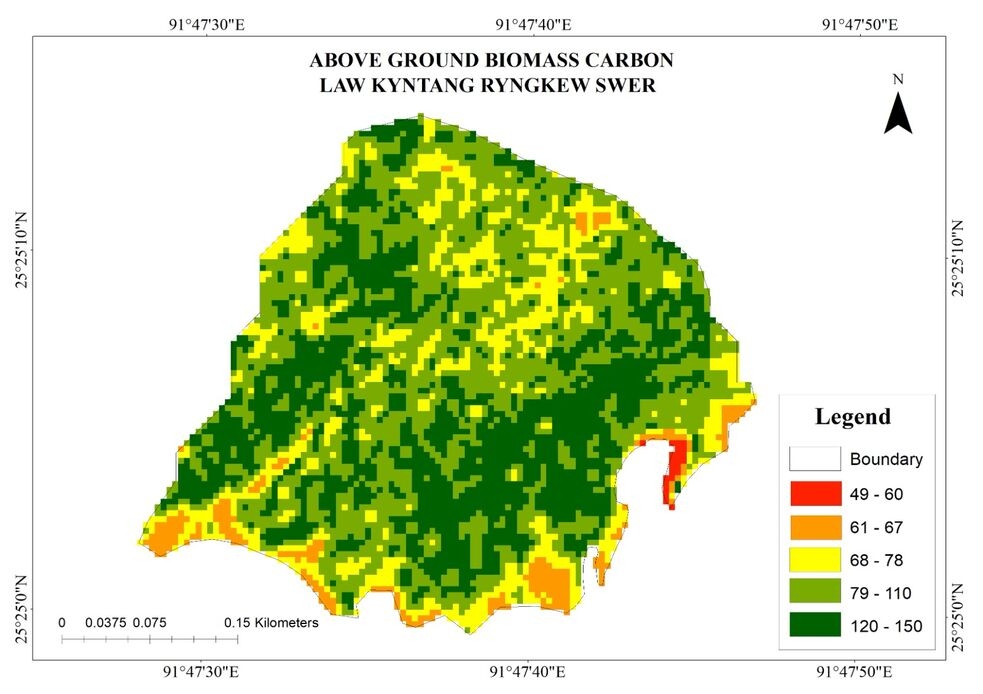
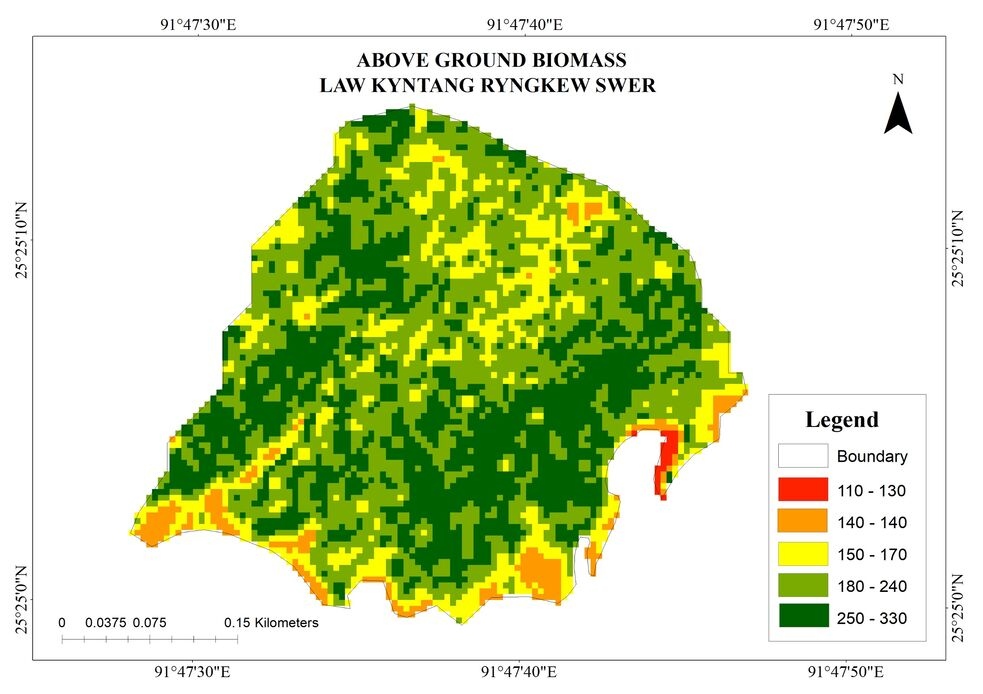
Researchers from Assam Royal Global University found that the Law Kyntang Ryngkew Swer Sacred Grove stores more than 100 megagrams of carbon per hectare, with the densest patches reaching up to 200 Mg/ha. Using a combination of field surveys, satellite imagery, and GIS mapping, the team showed how this 11-hectare community-protected forest functions as a vital carbon sink, locking away greenhouse gases that drive global warming.
The study revealed that undisturbed central zones contained the highest reserves, while edge areas showed lower values due to human activity and ecological gradients. Assessment involved systematic field inventory, tropical forest allometric equations, and NDVI (Normalized Difference Vegetation Index)–GIS regression modelling. The researchers identified five categories of carbon stock, ranging from 62 to 200 Mg ha⁻¹, demonstrating how topography, vegetation density, and disturbance influence storage capacity.
Interestingly, NDVI data showed a negative correlation with biomass because dense canopies saturated the index. Yet, calibrated models successfully mapped carbon distribution, underscoring how indigenous conservation traditions and modern technology can complement each other.
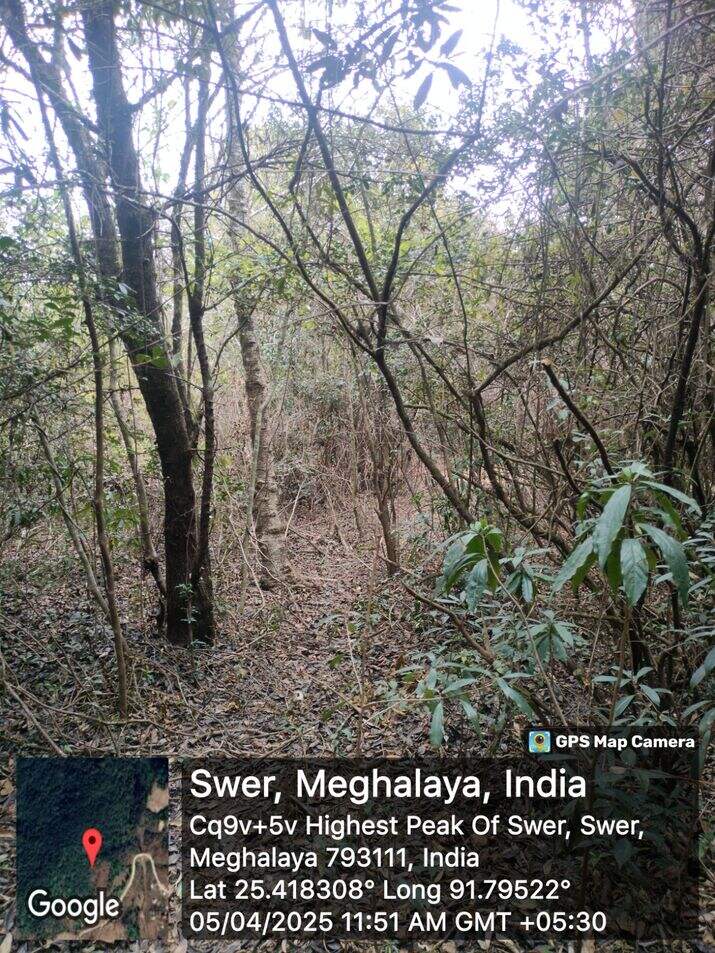
Traditional Khasi taboos—prohibiting tree felling, hunting, and resource extraction—have preserved the grove’s ecological integrity for centuries. As a result, it remains a refuge for ferns, orchids, and endemic tree species, representing one of the last strongholds of primary forest in the region.
“This is not just about one grove,” the authors noted. “With hundreds of such sacred forests dotting Meghalaya, their collective contribution to carbon sequestration and biodiversity could be immense.”
The findings highlight the importance of incorporating sacred groves into nature-based climate strategies. The study concludes that Law Kyntang Ryngkew Swer is not only a biodiversity refuge but also an “essential carbon sink sustained by community-led conservation,” recommending that such groves be included in REDD⁺ (Reducing emissions from deforestation and forest degradation in developing countries) frameworks and state climate policies.
Also Read: 4-year-old child goes missing from home as family still asleep; Search continues
Also Watch
Find latest news from every corner of Northeast India at hubnetwork.in, your online source for breaking news, video coverage.
Also, Follow us on-
Twitter-twitter.com/nemediahub
Youtube channel- www.youtube.com/@NortheastMediaHub2020
Instagram- www.instagram.com/ne_media_hub
Download our app from playstore – Northeast Media Hub