


Kohima, July 6: Nagaland has taken a significant leap in modern dental healthcare by successfully producing the state’s first fully 3D-printed monolithic complete dentures, signalling the arrival of advanced digital dentistry in the region.
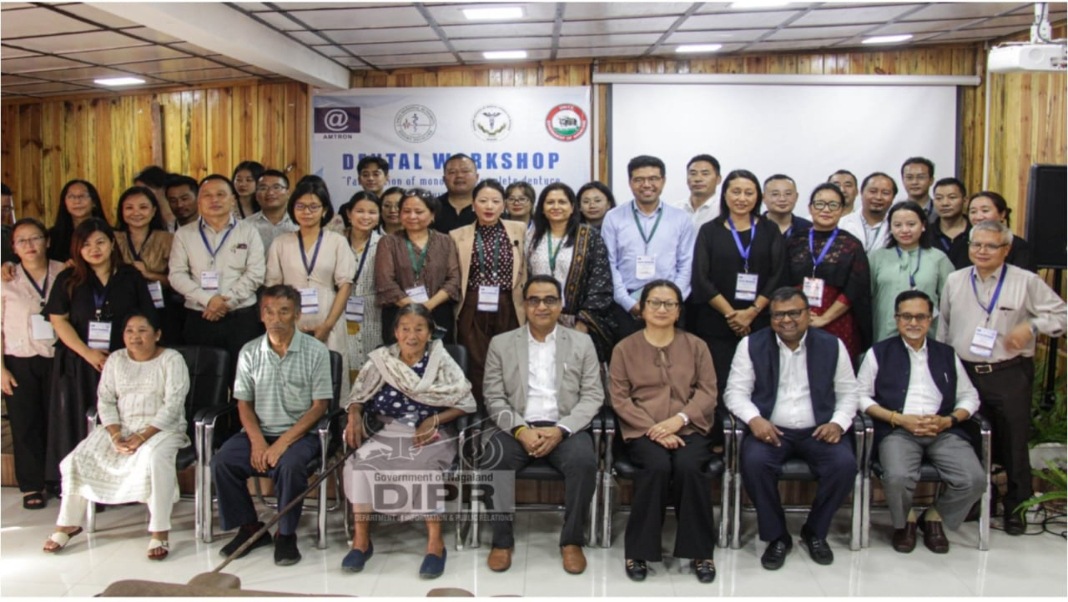
The milestone was achieved during a specialised workshop at the Naga Hospital Authority Kohima (NHAK), where around 30 dental professionals received hands-on training in the latest digital denture fabrication techniques using PolyJet 3D-printing technology.
Leading the demonstration, Dr Thungbeni P. Ngullie, Senior Resident at the Nagaland Institute of Medical Sciences and Research, completed the entire digital workflow and fitted the first five patients in the state with monolithic 3D-printed dentures.
Unlike conventional dentures that are assembled from multiple components, monolithic dentures are produced as a single multi-material unit, improving durability, aesthetics and precision.
The process combines conventional clinical procedures such as impression-taking and jaw relation recording with digital scanning, computer-aided design and high-resolution 3D printing.
Dr Ngullie explained that the PolyJet printer used during the workshop is capable of manufacturing up to 32 complete dentures in roughly 14 hours. The five dentures produced during the training were printed within five to six hours.
She said the technology dramatically streamlines denture production, cutting the conventional fabrication process from nearly 15 manual stages to just six or seven. Besides reducing the chances of human error, it shortens treatment time, minimises patient visits and allows damaged or misplaced dentures to be reproduced quickly using stored digital records.
The innovation is expected to particularly benefit elderly patients who require complete dentures by making treatment faster, more accurate and more comfortable.
Addressing participants, Health and Family Welfare Commissioner and Secretary Anoop Khinchi described digital dentistry as a transformative development that is reshaping healthcare through greater precision, efficiency and improved patient care.
He said the Nagaland government is committed to promoting advanced healthcare technologies and strengthening the capacity of dental professionals to adopt modern digital practices.
Khinchi also called for stronger collaboration between hospitals, academic institutions, industry and government agencies to expand digital dentistry and 3D-printing facilities beyond specialised centres, enabling district hospitals, dental colleges and community clinics across the state to benefit from the technology.
The successful fabrication of Nagaland’s first 3D-printed complete dentures marks an important milestone in the state’s efforts to modernise healthcare and improve access to advanced dental treatment.