

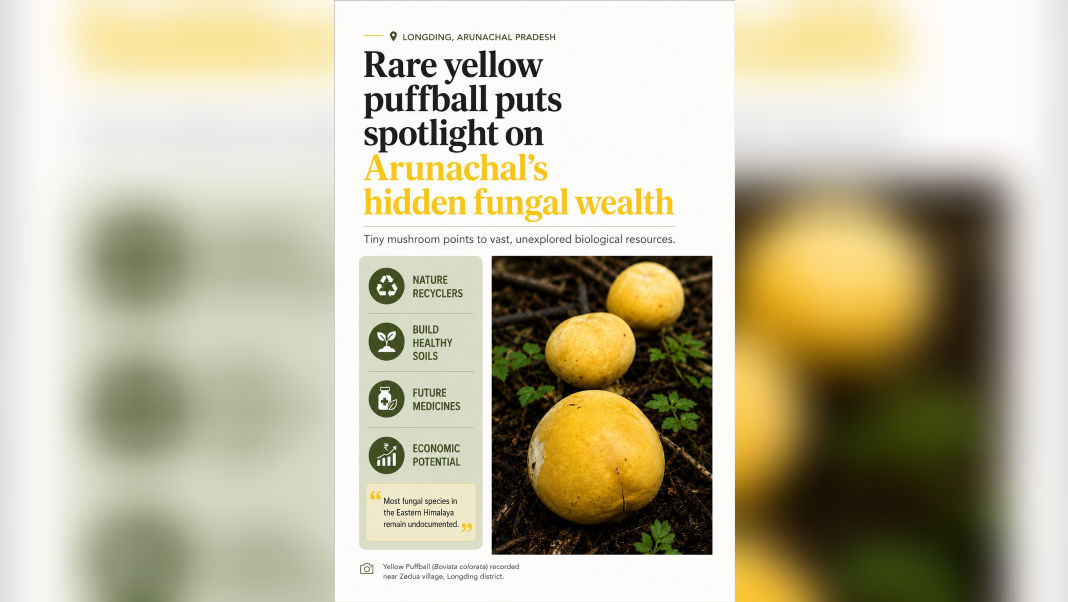

Longding, June 6: A small yellow mushroom discovered in the forests of Longding district is drawing attention to one of the least explored frontiers of Arunachal Pradesh’s biodiversity — its hidden fungal world.
Scientists from ICAR-Krishi Vigyan Kendra (KVK), Longding, have recorded a striking yellow puffball mushroom growing naturally on decaying woody debris and organic-rich forest soil near Zedua village. Tentatively identified as Bovista colorata, or the Yellow Puffball Mushroom, the finding could represent one of the earliest documented field records of the species from Longding district and potentially from Arunachal Pradesh itself.
At first glance, the discovery may appear modest. Yet for ecologists, fungi are among the most important organisms in any forest ecosystem.
Unlike plants, fungi do not produce their own food. Instead, they break down dead wood, fallen leaves and organic debris, releasing nutrients back into the soil and sustaining the natural recycling systems on which forests depend. Without fungi, ecosystems would gradually become overwhelmed by undecomposed organic matter.
The newly recorded puffball belongs to the genus Bovista, a group of fungi known for producing millions of microscopic spores inside a spherical fruiting body. When mature, these spores are dispersed by wind, rain or physical disturbance, allowing the species to spread across landscapes. In the process, these fungi help recycle plant waste, enrich soils and contribute to carbon and nutrient cycling.
The discovery comes from Arunachal Pradesh, part of the Eastern Himalayan biodiversity hotspot and one of the most species-rich regions on Earth. While the state’s birds, orchids and mammals have been widely studied, fungi remain among its least documented life forms.
Scientists estimate that only a fraction of India’s fungal diversity has been formally described. Although roughly 155,000 fungal species have been identified worldwide, researchers believe the true number could run into the millions. Much of the fungal diversity of the Eastern Himalaya remains unexplored, making every new record potentially significant.

That gap in knowledge carries both ecological and economic implications.
Fungi underpin forest health. They regulate nutrient cycling, support soil formation, influence carbon storage and create underground networks that help plants access water and nutrients. Many species are also valued for their medicinal, agricultural and industrial applications.
Research on puffball mushrooms has identified compounds with antioxidant, antimicrobial and anti-inflammatory properties. Certain species contain proteins, dietary fibre, essential amino acids and bioactive compounds that continue to attract scientific interest for potential pharmaceutical and biotechnological applications.
The economic potential is equally noteworthy. The global mushroom industry is worth billions of dollars annually, while wild mushrooms support livelihoods across mountain regions of Asia, Europe and North America. Scientists say a better understanding of Arunachal’s fungal diversity could eventually create opportunities in sustainable harvesting, conservation-linked enterprises, nutraceuticals and biotechnology.
The Longding discovery also highlights a recurring challenge in fungal science. Unlike birds or mammals, fungi are notoriously difficult to identify with certainty. Researchers note that microscopic examination and DNA barcoding will still be required before the mushroom’s identity can be conclusively confirmed.
Yet even at this preliminary stage, the yellow puffball serves as a reminder of how much remains unknown about the forests of Arunachal Pradesh.
Beneath the state’s celebrated mountains, orchids and wildlife lies a vast biological network quietly recycling nutrients, storing carbon, sustaining plant life and potentially harbouring future medicines.
The discovery in Longding suggests that some of Arunachal’s greatest natural treasures may not tower above the forest canopy.
In a state celebrated for its mountains, orchids and wildlife, the next great biodiversity story may be unfolding much closer to the ground – in the hidden fungal networks beneath Arunachal’s forests.
Also Read: Assam study reveals why aggressive breast cancer is more common in Northeast India
Also Watch
Find latest news from every corner of Northeast India at hubnetwork.in, your online source for breaking news, video coverage.
Also, Follow us on
Twitter-twitter.com/nemediahub
Youtube channel- www.youtube.com/@NortheastMediaHub2020
Instagram- www.instagram.com/ne_media_hub
Download our app from playstore – Northeast Media Hub