


Urmi Bhattacharjee
Guwahati, May 12: Road accidents continue to remain one of Assam’s biggest public safety concerns, with official data showing that the state is still losing lives at an alarming pace despite repeated enforcement drives and infrastructure expansion.
Recent road safety reviews by the Assam government revealed that the state recorded 4,219 accidents and 1,008 deaths between January and March this year alone. Officials admitted that nearly 11 people continue to die on Assam’s roads every single day. Nearly half the fatalities were reported from a cluster of districts that included Guwahati city, Kamrup, Nagaon, Hojai, Sonitpur, Golaghat and Barpeta.
National Crime Records Bureau data and transport department findings show overspeeding remains the single biggest factor behind fatal crashes, both nationally and within Assam. NCRB data for 2024 showed that over 61 percent of road accidents across India were linked to overspeeding, while dangerous driving, reckless overtaking and careless lane behaviour continued to remain major contributors.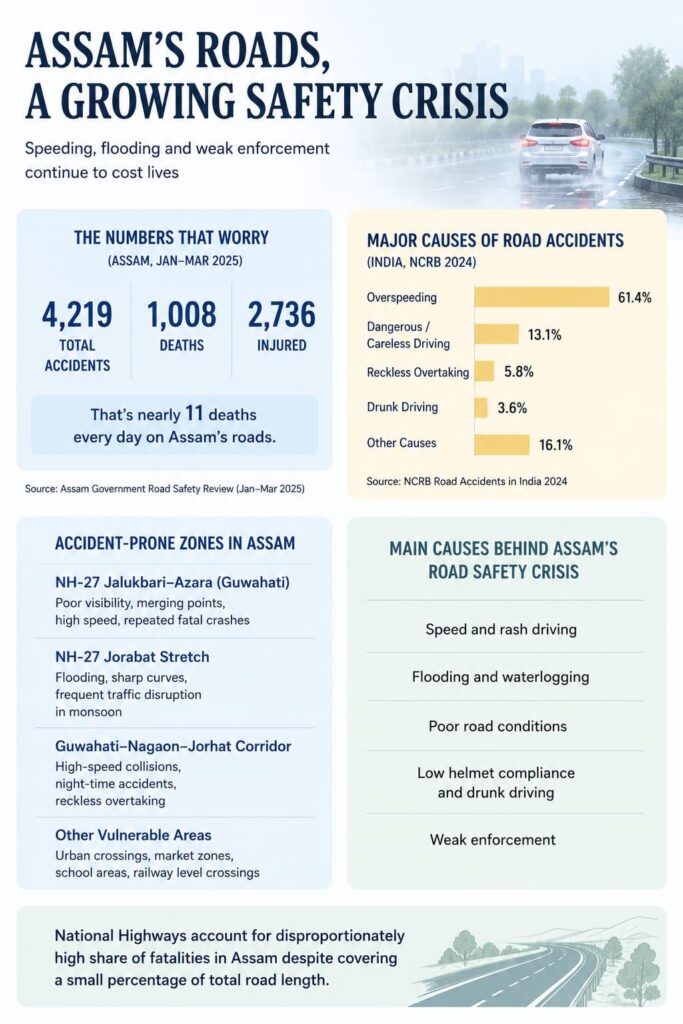
In Assam, several highway stretches have repeatedly emerged as accident-prone corridors.
Traffic officials and road safety activists have often flagged sections of NH-27, especially the Jalukbari-Azara stretch near Guwahati, for repeated fatal crashes, poor visibility, dangerous merging points and inadequate safety infrastructure.
The Guwahati-Nagaon-Jorhat highway corridor too has repeatedly been associated with high-speed collisions, night-time crashes and reckless overtaking. Road safety reports have pointed out that National Highways account for a disproportionately high share of fatalities in Assam despite covering only a small percentage of total road length in the state.
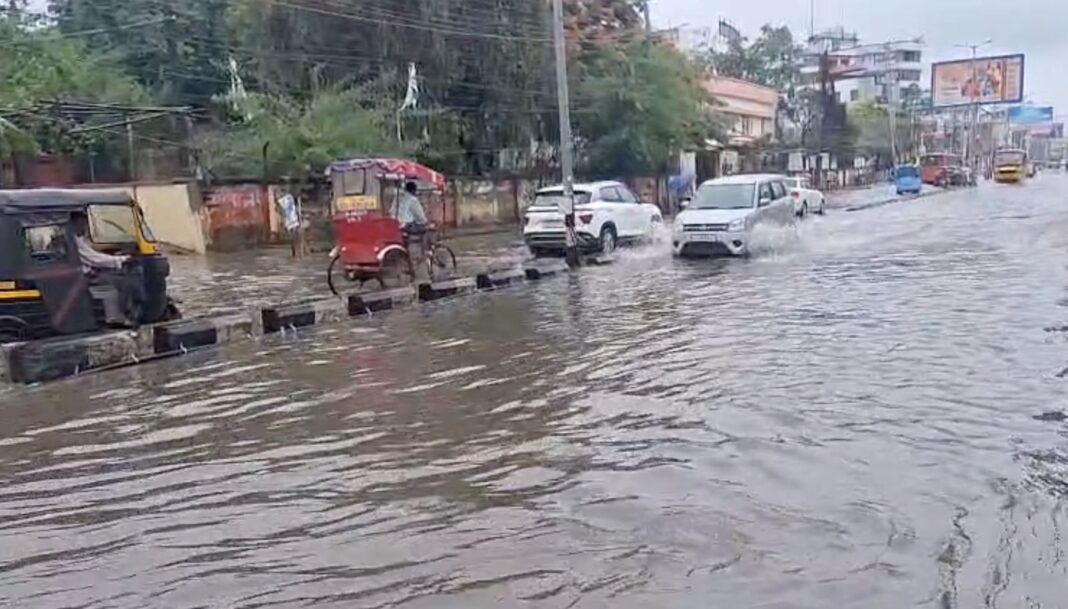
Monsoon flooding has become another major safety hazard.
In Guwahati, heavy rainfall routinely submerges roads across several parts of the city, including important traffic corridors near Anil Nagar, GS Road, Jorabat and Beltola. Waterlogging reduces visibility, damages road surfaces and hides potholes, making roads especially dangerous during evening traffic hours. Flooded stretches of NH-27 near Jorabat have repeatedly triggered severe traffic disruption and accident risks during heavy rainfall.
Road engineering failures are increasingly being discussed alongside driver behaviour.

Road safety reports and transport experts have repeatedly highlighted potholes, damaged dividers, uneven carriageways, weak lighting, poor signage, illegal highway parking and unsafe highway entry points as factors behind several fatal accidents. Some experts argue that accident investigations in Assam still focus too heavily on blaming drivers while ignoring larger infrastructure and engineering failures.
Two-wheelers continue to remain among the most vulnerable categories on Assam’s roads.
Traffic officials say low helmet compliance, speeding and late-night riding have significantly contributed to fatalities among younger riders. Data from Guwahati traffic police showed helmet violation cases rose sharply in recent years, crossing 56,000 cases by October 2024. Drunk driving cases too remained consistently high.
Festival periods and late-night traffic continue to worsen the problem.
Officials say Bihu celebrations, Durga Puja, New Year festivities and wedding seasons often witness spikes in road accidents because of drunk driving and speeding. Late-night highway movement, especially involving trucks and high-speed passenger vehicles, has also remained a persistent concern.
The Assam government has announced stricter enforcement measures, including black spot rectification, more surveillance cameras, helmet enforcement drives, breath-analyser checks and improved trauma care systems under the PM RAHAT scheme. Authorities have also directed agencies such as NHAI and NHIDCL to prioritise accident-prone highway stretches for corrective work.
Despite these measures, traffic experts say Assam’s road safety crisis can no longer be viewed only as a policing issue.
Rapid urbanisation, rising vehicle ownership, weak pedestrian infrastructure, poor drainage planning and inconsistent enforcement have together created a situation where roads are becoming increasingly unpredictable, especially during monsoon months.
For thousands of commuters across Assam, road travel today involves negotiating speeding vehicles, damaged roads, flooded stretches and weak traffic discipline all at the same time.