

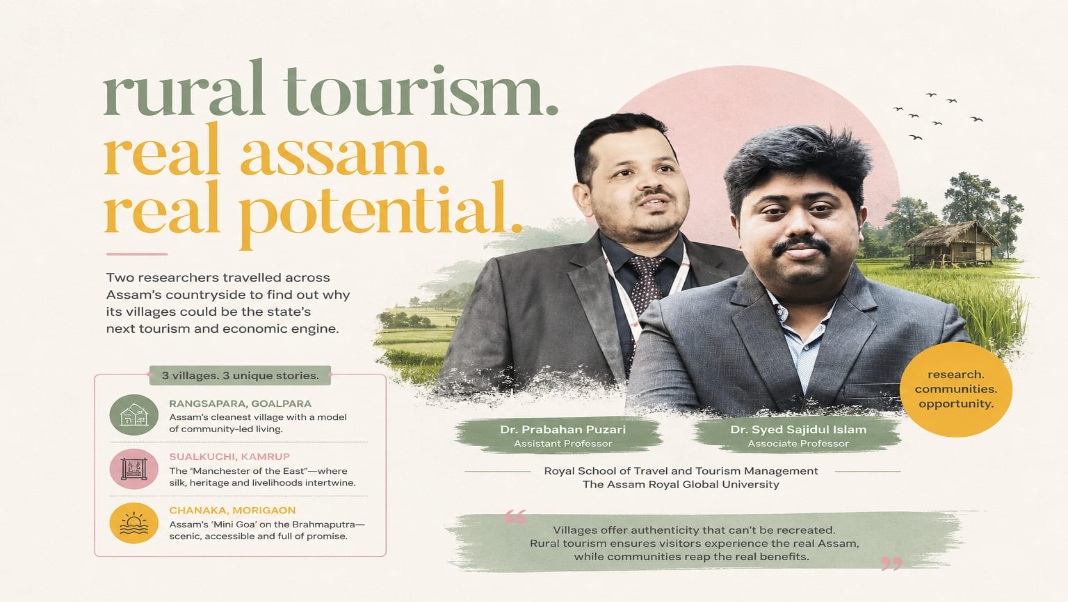

How two tourism researchers believe Assam’s villages—not just its famous landmarks—could power the state’s next tourism and economic boom.
Urmi Bhattacharjee
Guwahati, June 29: Forget the crowded beaches of Goa for a moment. Assam has its own “Mini Goa” on the banks of the Brahmaputra. Meghalaya’s Mawlynnong may be celebrated as Asia’s cleanest village, but Assam, too, has a village quietly setting an inspiring benchmark in community-led cleanliness. Add to that an ancient silk-weaving settlement where every lane tells a story of craftsmanship, and a different picture of Assam begins to emerge—one that rarely finds space in mainstream travel itineraries.
This is the Assam that Dr. Prabahan Puzari, Assistant Professor, and Dr. Syed Sajidul Islam, Associate Professor, at the Royal School of Travel and Tourism Management, The Assam Royal Global University, set out to discover.
Instead of revisiting destinations that already dominate travel brochures, the two researchers spent months travelling through rural Assam, interacting with local communities, tourists and stakeholders to understand whether lesser-known villages could become the state’s next tourism success stories.
Their answer is a confident yes.
Presented at the SMART-MET 2026 International Conference, their study identifies Rangsapara in Goalpara, Sualkuchi in Kamrup and Chanaka in Morigaon as villages that showcase Assam’s enormous yet underexplored rural tourism potential. More importantly, the research argues that rural tourism is no longer just about attracting visitors—it can generate employment, strengthen local entrepreneurship, preserve indigenous culture and become one of Assam’s strongest engines of inclusive economic growth.
“Our intention was to explore villages with distinct identities that have never received the attention they deserve,” the researchers said.
“Everybody knows Kaziranga and Majuli. We wanted to understand whether villages with unique stories, traditions and landscapes could become tourism destinations that directly improve rural livelihoods.”
The findings are encouraging.
Based on surveys involving 150 tourists and 60 local stakeholders, nearly 73.8 per cent of local respondents rated the tourism potential of these villages as high or very high, while more than 63 per cent of tourists said they would happily revisit and recommend them to others despite the relatively modest tourism infrastructure.
Perhaps the most interesting finding was how travellers are choosing destinations today.
The researchers found that visitors are increasingly looking beyond iconic landmarks. Instead, they seek authentic village life, traditional cuisine, local crafts, organic produce, riverside landscapes and genuine interactions with local communities. Social media and word-of-mouth recommendations have now overtaken conventional tourism campaigns in bringing visitors to these villages.
Each destination, they found, offers a completely different experience.
Rangsapara, recognised as Assam’s cleanest village, impressed the researchers not merely for its spotless surroundings but for the remarkable community discipline behind it. While Mawlynnong has earned international recognition, they believe Rangsapara deserves similar attention for demonstrating how collective responsibility can transform an entire village. Strict community rules on sanitation, drinking water, plastic use, alcohol and drugs have made cleanliness a way of life rather than a government campaign.
Chanaka, popularly known as Assam’s “Mini Goa”, offers an entirely different appeal. Located along the Brahmaputra in Morigaon district, its sandy riverbanks, scenic beauty and proximity to Guwahati have made it an emerging leisure destination. Yet, the researchers believe its real strength lies not in the nickname but in its potential to evolve into a sustainable rural tourism model where local communities remain the primary beneficiaries.
Sualkuchi, known worldwide as the “Manchester of the East”, is far more than Assam’s silk capital. Traditional weaving, bamboo architecture, birdwatching, temples, local cuisine and the nearby Gandhmow agro-tourism village together offer visitors a rich cultural experience while creating livelihood opportunities for artisans and rural entrepreneurs.
The study, however, also highlights the gaps.
Road connectivity, accommodation, visitor amenities and organised promotion remain inadequate in several locations. More than half the stakeholders surveyed felt that existing government support is still insufficient to unlock the full potential of rural tourism.
Even so, visitor satisfaction remains remarkably high.
Nearly 77 per cent rated their overall experience as good or excellent, while 80 per cent appreciated the warmth and hospitality of local communities—qualities the researchers describe as Assam’s greatest competitive advantage in today’s experience-driven tourism market.
“The potential for rural tourism in these villages is tremendous,” said Dr. Prabahan Puzari.
“Rural tourism is much more than bringing visitors to a place. It creates entrepreneurship, generates employment, preserves traditional culture and ensures that local communities become direct beneficiaries of development.”
His colleague, Dr. Syed Sajidul Islam, believes Assam now has an opportunity to rethink the way it promotes tourism.
“Today’s traveller is searching for authenticity. Villages offer culture, cuisine, crafts, agriculture and community life that cannot be recreated elsewhere. Rural tourism allows visitors to experience the real Assam while ensuring that economic benefits remain within the community,” he said.
The researchers have also proposed a practical roadmap for the Assam Government. Their recommendations include aggressively promoting lesser-known destinations, introducing guided rural tourism circuits, developing dedicated spaces to showcase local cuisine and culture, investing in eco-friendly infrastructure such as government-supported cafeterias and homestays, and involving village institutions directly in tourism planning.
They have further recommended identifying more unexplored rural destinations across Assam and working with historians and anthropologists to document their history, heritage and cultural significance before promoting them. Equally important, they believe every destination should have its own distinct identity, supported by carefully crafted branding and memorable taglines that genuinely reflect its unique character.
“Every village has its own story,” the researchers said.
“Our responsibility is to discover that story, preserve its authenticity and present it to the world in a way that benefits the community.”
For Dr. Puzari and Dr. Islam, Rangsapara, Chanaka and Sualkuchi are only the beginning.
They believe Assam is home to dozens of villages with equally compelling stories waiting to be discovered.
Their message is simple: the state does not need to create new tourist attractions—it first needs to recognise the extraordinary ones it already has.
With thoughtful planning, stronger infrastructure and meaningful community participation, Assam’s next tourism success story may well begin not at its most famous landmarks, but in the villages that have quietly preserved the state’s culture, heritage and way of life for generations.