


Urmi Bhattacharjee
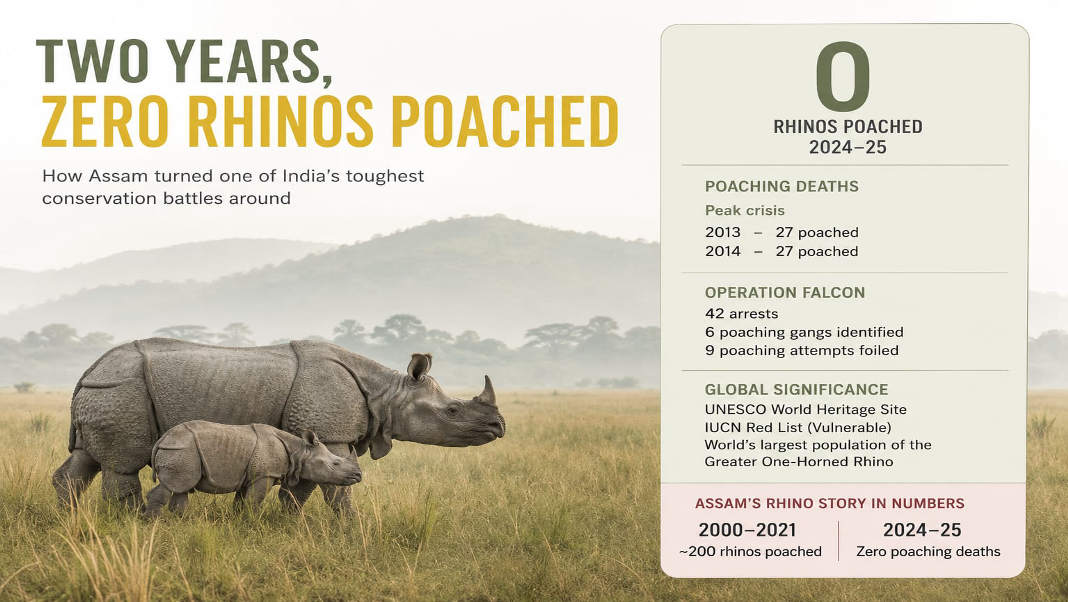
Guwahati, June 5: Home to the UNESCO World Heritage Site of Kaziranga National Park and the world’s largest population of the Greater One-Horned Rhinoceros, Assam occupies a unique place in global wildlife conservation. The iconic species, listed as Vulnerable on the International Union for Conservation of Nature (IUCN) Red List and one of only five surviving rhino species in the world, has become synonymous with the state’s natural heritage. Today, Assam is celebrating a milestone that few would have imagined during the height of the poaching crisis a decade ago: two consecutive years without a single rhino being lost to poachers.
The achievement marks a remarkable turnaround for a species that was once at the centre of one of India’s most persistent wildlife crime battles.
A little over a decade ago, reports of rhino poaching routinely dominated headlines from Kaziranga and other protected areas. In 2013 and 2014 alone, around 27 rhinos were killed each year by poachers, making those among the deadliest years on record. Between 2000 and 2021, nearly 200 rhinos were lost to poaching across Assam’s protected areas, including Kaziranga, Orang National Park, Pobitora Wildlife Sanctuary and Manas National Park.
At the time, wildlife investigators described poaching as a sophisticated criminal enterprise involving local operatives, informants, transporters, middlemen and international trafficking networks driven by the lucrative illegal trade in rhino horn. The challenge confronting Assam was not merely protecting rhinos inside national parks but dismantling an organised network that stretched far beyond forest boundaries.
Yet the story that unfolded over the next decade would become one of India’s most significant conservation successes.
The turnaround was driven by a combination of political commitment, stronger law enforcement, technological intervention and relentless field-level protection by forest personnel. Over the years, the Assam Forest Department expanded anti-poaching infrastructure across rhino habitats, increased armed patrols, strengthened intelligence networks and introduced technology-driven surveillance systems.
Hundreds of anti-poaching camps were established across vulnerable stretches of Kaziranga and other protected areas. Drones, camera traps, GPS-enabled monitoring systems, real-time communication networks and intelligence-led operations gradually became part of routine wildlife protection efforts. Forest authorities also worked closely with Assam Police and other agencies to target wildlife trafficking networks operating beyond park boundaries.
Conservationists note that the battle was never simply against armed poachers. Investigations repeatedly exposed the role of larger trafficking networks, local informants, transporters and illegal wildlife trade routes operating far beyond protected areas. Breaking these support systems proved just as important as protecting rhinos inside the parks. Authorities say intelligence-led operations have increasingly focused on dismantling entire networks rather than merely responding after a poaching incident occurs.
One of the most visible outcomes of this strategy has been Operation Falcon, launched after rhino killings in 2024. According to official figures, the operation led to the arrest of 42 suspected poachers, the identification of six poaching gangs and the foiling of nine poaching attempts. Investigators say the operation helped dismantle organised networks linked to the illegal rhino horn trade and disrupted trafficking routes extending beyond Assam.
The success is particularly significant because poaching was never the only threat facing the species.
Every year, the Brahmaputra transforms Kaziranga’s landscape. Vast stretches of grassland and low-lying habitat are submerged during floods, forcing rhinos, deer, wild buffaloes and other animals to move towards higher ground. Historically, these seasonal migrations made rhinos especially vulnerable. As animals moved towards the Karbi Anglong hills and crossed highways, forest edges and human settlements, poachers often exploited these predictable routes.
For years, flood season was regarded as one of the most vulnerable periods for rhino protection.
Authorities gradually responded by constructing additional artificial highlands inside Kaziranga, strengthening flood-season patrols, deploying special monitoring teams, increasing surveillance along animal corridors and regulating traffic movement during peak wildlife crossings. These measures, combined with enhanced anti-poaching vigilance, helped reduce some of the vulnerabilities that poachers had previously exploited during annual floods.
The recovery of Assam’s rhinos has also unfolded across a wider conservation landscape than Kaziranga alone. Significant populations are now protected in Orang National Park, Pobitora Wildlife Sanctuary and Manas National Park, creating a broader safety net for the species and reducing the risks associated with concentrating a globally important population in a single protected area.
The results are now visible on the ground.
Kaziranga today supports the largest population of Greater One-Horned Rhinoceros anywhere in the world. Together with populations in Orang, Pobitora and Manas, Assam remains the global stronghold of a species that had once been pushed close to extinction by hunting, habitat loss and organised wildlife crime.
The achievement has attracted international attention because the Greater One-Horned Rhinoceros is widely regarded as one of the world’s most successful large-mammal conservation recoveries. From a population that had dwindled to only a few hundred animals at the beginning of the twentieth century, the species has rebounded largely due to sustained conservation efforts centred in Assam and parts of Nepal.
Yet conservationists caution against complacency.
Habitat fragmentation, annual floods, encroachment pressures, infrastructure development and human-wildlife conflict continue to pose challenges. The pressure on wildlife habitats remains significant in several landscapes surrounding protected areas. International demand for rhino horn has also not disappeared, meaning enforcement agencies must remain constantly vigilant.
Many conservationists argue that the next phase of rhino conservation will be as much about habitat security as anti-poaching. Protecting animal corridors, restoring degraded habitats and ensuring that growing rhino populations have sufficient space to expand may ultimately determine the long-term future of the species.
Nevertheless, the contrast with a decade ago is striking.
There was a time when Assam’s rhinos were discussed largely in the context of poaching deaths. Today, the conversation is increasingly about population growth, habitat management and future translocations.
The state still faces annual floods, habitat pressures and the continuing threat of illegal wildlife trade. Yet two consecutive years without a poaching death suggest that one of the world’s most closely watched conservation battles has entered a very different chapter.
In a country where environmental stories are often marked by decline and loss, Assam’s rhino story stands out as a rare reminder that sustained political will, strong enforcement, community participation and long-term conservation planning can still change the trajectory of a species.
Also Read: ILP key to railway talks, says Meghalaya Govt
Also Watch
Find latest news from every corner of Northeast India at hubnetwork.in, your online source for breaking news, video coverage.
Also, Follow us on
Twitter-twitter.com/nemediahub
Youtube channel- www.youtube.com/@NortheastMediaHub2020
Instagram- www.instagram.com/ne_media_hub
Download our app from playstore – Northeast Media Hub