



ROOPAK GOSWAMI
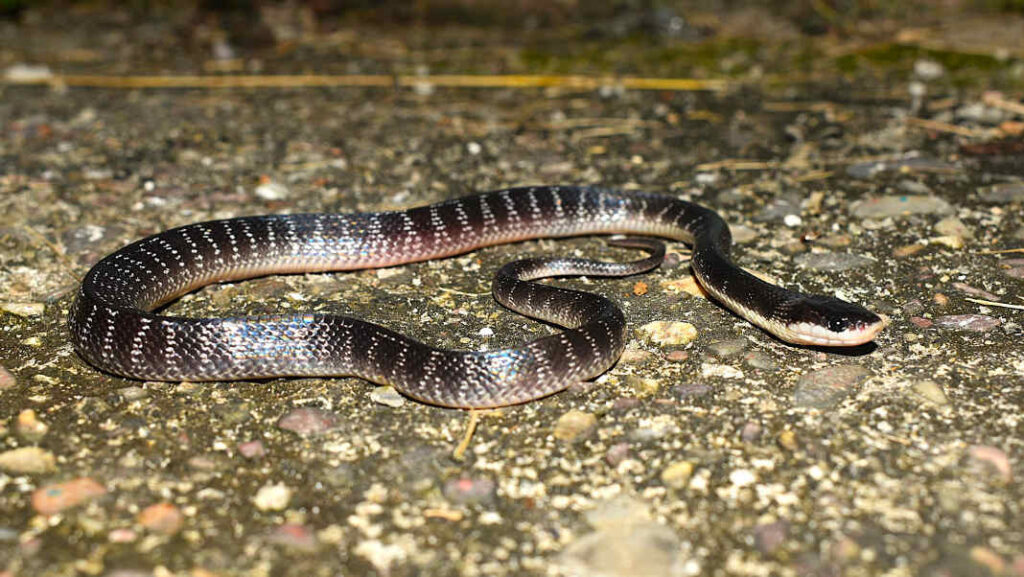
Guwahati, April 26: A rare and medically significant snake species has been recorded in Assam for the first time, with researchers documenting the presence of Wall’s Krait (Bungarus walli) in Raimona National Park.
The finding, published in the Journal of Threatened Taxa, emerges from a field study conducted by Bijay Basfore, Abhi Medhi, Nazrul Islam, Rathin Barman, Madhurima Das, Dr. Anjana Singha Naorem and Dr. Jayaditya Purkayastha, marking a significant addition to the state’s reptile records.
The record is based on the sighting of a juvenile specimen during a herpetofaunal survey on the night of July 17, 2025. Measuring approximately 460 mm, the snake was encountered around 8:30 pm in the park’s Western Range, moving along a moist, semi-shaded forest stream bordered by dense vegetation—conditions typical of its elusive habitat preferences.
A highly venomous species with a fragmented distribution across the Indian subcontinent, Wall’s Krait has previously been reported from Uttar Pradesh, Bihar, Odisha and West Bengal, with a more recent record from Tripura. Its detection in Assam extends the known eastern limit of its range and situates it within a critical transboundary forest landscape.
Raimona National Park lies along the Indo–Bhutan border and shares contiguous habitat with Phipsoo Wildlife Sanctuary and Buxa Tiger Reserve—a connected ecological corridor that researchers say likely facilitates species movement and distribution.
The snake was identified through distinct morphological features, including a glossy black body marked with narrow white bands and characteristic scale patterns matching published descriptions.
Researchers caution that Wall’s Krait is often misidentified as other krait species such as the Common Krait (Bungarus caeruleus) or Sind Krait (Bungarus sindanus). Such confusion can have serious implications in snakebite cases, as antivenom effectiveness may vary between species.
The discovery underscores the importance of systematic wildlife surveys in the relatively underexplored forests of western Assam and reinforces Raimona’s emerging role as a biodiversity hotspot for lesser-known species. The survey also documented several other reptile and amphibian species, pointing to a rich and complex ecosystem.
“Our study highlights the vast, still untapped potential for biodiversity discovery in Assam—through surveys in Raimona National Park, we described a gecko new to science and recorded a snake species for the first time in the state. Despite a history of logging, land conversion, and encroachment, the park is showing signs of recovery, and with sustainable ecotourism, it can become a stronghold for conservation and a focus for policy attention,” said Bijay Basfore.
He added that improved documentation of venomous snakes is crucial not only for biodiversity research but also for enhancing awareness and preparedness in snakebite-prone regions, where human activity frequently overlaps with wildlife habitats.
Also Read: Northeast bamboo sector gets PM push in Mann Ki Baat
Also Watch
Find latest news from every corner of Northeast India at hubnetwork.in, your online source for breaking news, video coverage.
Also, Follow us on
Twitter-twitter.com/nemediahub
Youtube channel- www.youtube.com/@NortheastMediaHub2020
Instagram- www.instagram.com/ne_media_hub
Download our app from playstore – Northeast Media Hub

 in Raimona National Park.)