

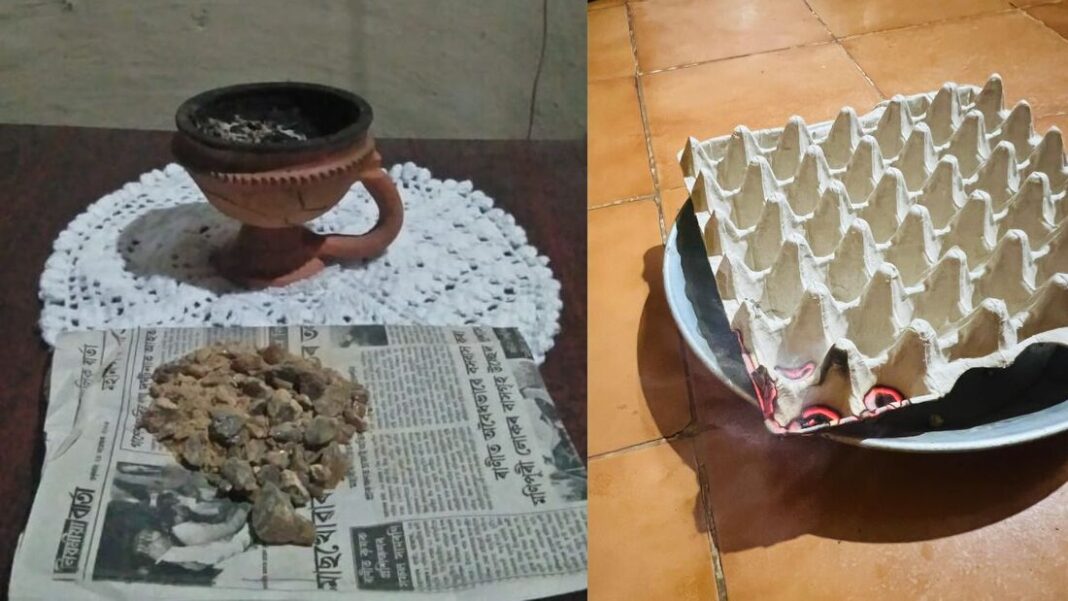

Shillong, June 14: Would you reach for a bottle of synthetic mosquito repellent—or trust the age-old wisdom of burning egg trays, neem leaves, or camphor to keep those buzzing menaces at bay?
A new scientific study from Northeast India suggests that your grandmother’s smoky remedies may not only be eco-friendly but surprisingly effective—offering the world a low-cost, low-risk alternative to chemical repellents in the battle against mosquito-borne diseases.
Researchers from the University of Science & Technology Meghalaya (USTM) Dr. Lalit Saikia, Ms. Tanjima Tarique Laskar, Dr. Mautushi Das and from The Assam Royal Global University Dr. Sudarshana Borah, Prof. (Dr.) Atanu Bhattacharjee, Prof. (Dr.) Debarupa Dutta Chakraborty, Prof. (Dr.) Prithviraj Chakraborty, Dr. Monalisa Bora Deka, conducted a sweeping survey across 50 districts in Northeast India. Their findings, now published in the International Journal of Environmental Sciences, reveal a vibrant, under-recognized tradition of indigenous mosquito control methods rooted in tribal and rural practices
Amid rising cases of Malaria (44%), Dengue (30%), Chikungunya (13%), and Japanese Encephalitis (11%), the study highlights a range of homegrown repellents. Among them, the burning of egg trays (used by 32.2% of respondents) emerged as the most common, followed closely by Dhuna (30.4%)—a resin-based incense deeply embedded in regional rituals. Other widely used natural mixtures include citronella, peppermint, neem leaves, camphor, and even orange peels.
“These traditional practices are not just cultural holdovers,” the authors note. “They are practical, accessible, and environmentally safe alternatives—especially in areas where healthcare access is limited and vector control is a logistical challenge.”
Importantly, 57.9% of respondents said traditional repellents are effective, with 14.6% strongly agreeing—an endorsement that signals both lived experience and community trust. Still, the study warns of a slow decline in their use, owing to perceived inefficacy, dwindling material availability, and time constraints.
“This is concerning,” the authors write, “as 29.8% now rely on synthetic liquids and 37.4% on mosquito coils or incense sticks—products that may contribute to indoor air pollution and chemical exposure risks. Traditional methods, by contrast, have minimal ecological or dermatological impact.”
The study also aligns traditional remedies with modern scientific understanding. Compounds such as azadirachtin (from neem), citronellal (citronella), eugenol (clove), thujone (wormwood), and limonene (orange peel) are all known bioactive agents with proven repellent properties.
However, the lack of standardization, documentation, and consistent formulation continues to hinder wider adoption. “There’s a huge opportunity here,” the authors suggest. “Neem- and citronella-based products could be further refined and validated, reducing reliance on chemical-based interventions.”
The researchers advocate for a hybrid approach—merging traditional knowledge with modern science. The fact that 72.5% of respondents expressed willingness to support traditional methods for mosquito control adds weight to the strategy, although 22.8% reported uncertainty and 4.7% disagreed, underscoring the need for awareness campaigns.
“By addressing knowledge gaps and building community confidence, these practices could complement existing public health interventions—especially in the unique socio-ecological landscape of Northeast India,” the study concludes.
Also Read: Manipur: Govt restores mobile internet in five Valley districts
Also Watch
Find latest news from every corner of Northeast India at hubnetwork.in, your online source for breaking news, video coverage.
Also, Follow us on-
Twitter-twitter.com/nemediahub
Youtube channel- www.youtube.com/@NortheastMediaHub2020
Instagram- www.instagram.com/ne_media_hub
Download our app from playstore – Northeast Media Hub