


Urmi Bhattacharjee
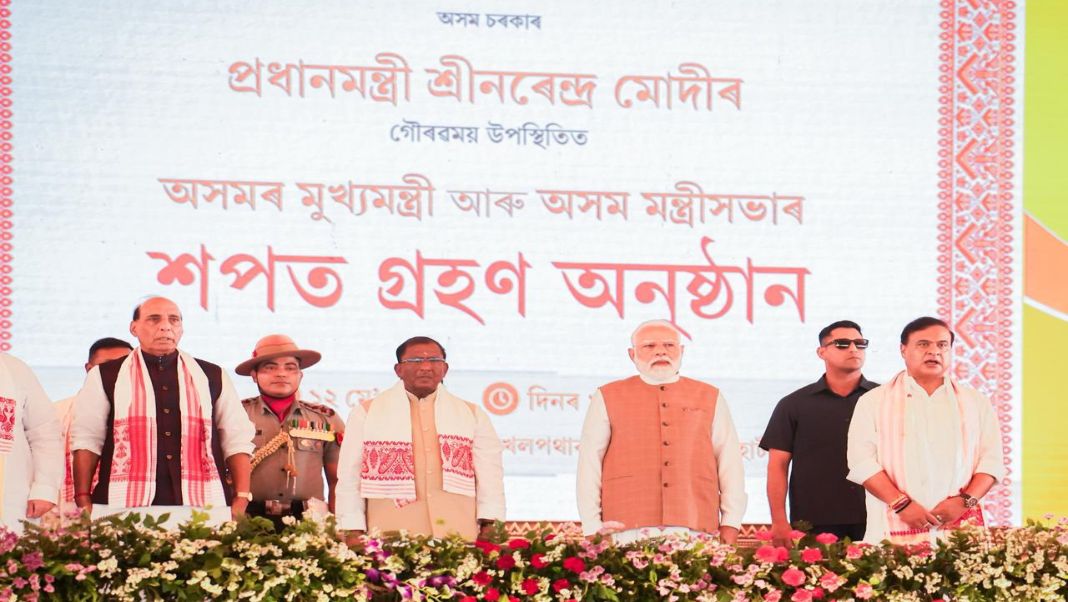
Guwahati, May 12: Prime Minister Narendra Modi, Home Minister Amit Shah, BJP president J. P. Nadda and around 20 chief ministers marked Himanta Biswa Sarma’s return to the throne of Assam in an oath-taking ceremony that saw the participation of political leaders from across India.
The gathering at the Veterinary College Ground in Khanapara was called “huge” and “larger than what usually accompanies such an occasion” by observers and, on Sunday night, even by party functionaries. By the end of it, all eyes were on Guwahati, which became the centre of national politics on Monday, as this was perhaps the biggest swearing-in event the Northeast had ever witnessed.
The participation of Modi, Shah, Nadda, several Union ministers and leaders from nearly 20 states was politically significant.
For a long time, the Northeast remained a region where the optics of national politics, largely dictated from Delhi, barely reached at this scale. This ceremony demonstrated how strongly Assam has entered the political imagination of the BJP.

The oath of office was administered to Sarma by Governor Lakshman Prasad Acharya, officially beginning the NDA government’s second consecutive term in Assam.
Joining him on stage were senior BJP leaders Ranjeet Kumar Dass and Rameswar Teli, AGP’s Atul Bora and BPF’s Charan Boro, all of whom became part of Sarma’s new government. Ajanta Neog was also sworn in by the Governor as minister in the new cabinet.
BJP sources indicated that the cabinet may be expanded in two or three phases soon and that the new ministry could eventually have between 18 and 19 ministers.
The NDA swept the Assembly elections held earlier this year in Assam and secured a massive mandate by winning 102 seats in the 126-member Assembly.
BJP alone won 82 seats, while AGP and BPF secured 14 and 4 seats respectively. The result marked the beginning of the NDA’s third straight term in Assam.
The political importance of the oath-taking ceremony was not limited to optics alone. It also reflected the messaging and direction the BJP now wants to project under Sarma’s second term.
From political expansion mode, the BJP is expected to move toward what Sarma repeatedly described as “execution mode.” Before taking oath, he had stated on several occasions that the government’s main focus would now be implementation of poll promises and projects already underway.
Sensitive political issues such as land eviction drives, illegal immigration and NRC-related concerns are expected to remain central themes during the government’s second term.
Sarma has repeatedly maintained that protection of land and Assamese identity remains central to his politics. “We have protected our land and that is very important. Assam’s identity is supreme,” he had said recently.
The ceremony also marked another major milestone in the political journey of Himanta Biswa Sarma, who quit the Congress in 2015 after a long political power struggle with former Chief Minister Tarun Gogoi before joining the BJP.
Over the years, he emerged as the BJP’s biggest political face in Assam and one of the party’s most influential strategists in the Northeast.
Supporters describe him as decisive, sharp and politically aggressive, while critics accuse him of deepening religious polarisation through identity-driven politics.
Yet across Assam’s political spectrum, there is broad agreement on one thing: Himanta Biswa Sarma today remains impossible to ignore in any political conversation around the state.