

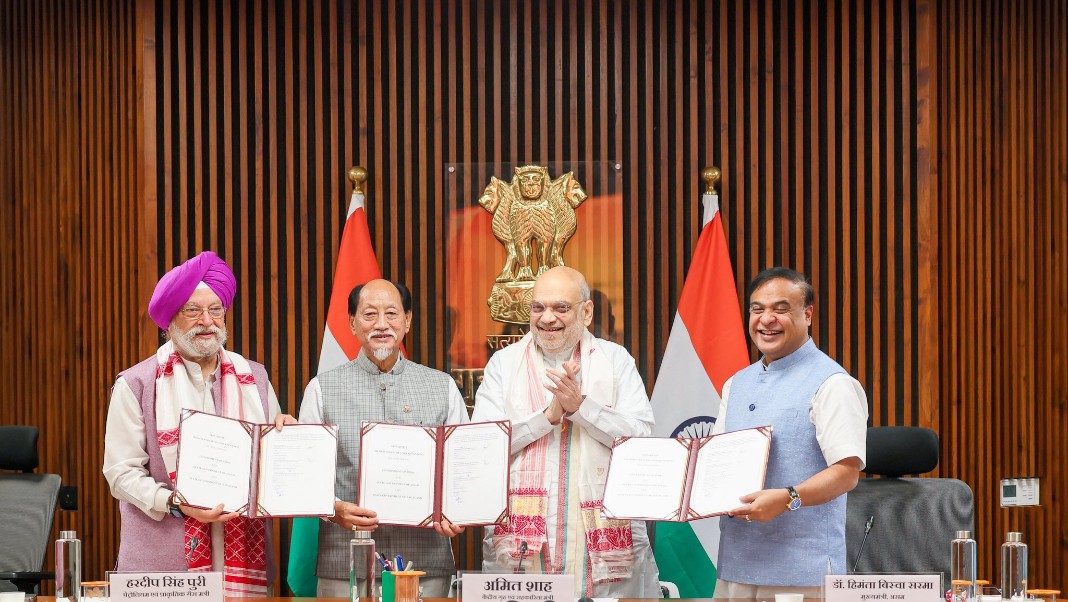

Guwahati, June 12: As tensions involving Iran, Israel and the United States continue to fuel concerns over global energy supplies, the Centre’s latest agreement with Assam and Nagaland to unlock oil and gas exploration in the Northeast is being viewed as a significant step towards strengthening India’s energy security.
The tripartite Memorandum of Understanding (MoU), signed in New Delhi on Thursday by the Centre and the governments of Assam and Nagaland, seeks to facilitate petroleum exploration and production in the Assam-Nagaland boundary areas—regions that have remained largely underexplored due to decades of disputes and operational uncertainty.
Linking the agreement to the current global energy situation, Union Home Minister Amit Shah said the pact would contribute to India’s long-term goal of becoming more self-reliant in energy.
“A nation’s development is impossible without energy,” Shah said. Referring to ongoing geopolitical conflicts involving the US, Iran and Israel, he noted that while it was difficult to predict how quickly the agreement would benefit India amid current global uncertainties, it would eventually provide relief by expanding domestic energy production and reducing dependence on external sources.
What changes with the agreement?
The MoU establishes a framework for oil and gas exploration in identified areas along the Assam-Nagaland border and provides operational clarity for future projects.
More importantly, Shah disclosed that the Nagaland government has agreed to permit oil exploration beyond the six designated fields that had been under discussion for years.
“The Government of Nagaland has agreed to oil exploration across the entire state. The Government of Assam is also in agreement. This is a win-win situation for all stakeholders,” he said.
The agreement is expected to provide greater certainty for exploration companies, improve coordination between stakeholders and create a more stable environment for investment in the upstream petroleum sector.

Why does it matter?
India imports nearly 85 per cent of its crude oil requirements, making it vulnerable to global price shocks and supply disruptions.
The Northeast has long been recognised as one of India’s hydrocarbon-rich regions. Assam is home to some of the country’s oldest oilfields, while geological studies have indicated significant untapped reserves in neighbouring states, including Nagaland.
However, disputes and regulatory challenges have often slowed exploration efforts.
By addressing some of these long-standing obstacles, the new agreement could help unlock reserves that have remained inaccessible for years.
Shah said current extraction levels of around 1,000-1,500 barrels per day could increase more than tenfold if exploration expands successfully.
While such estimates will depend on future discoveries and commercial viability, the statement underscores the expectations surrounding the agreement.
Can it reduce India’s import dependence?
The answer will depend on what future exploration reveals.
Even if production rises significantly in the Assam-Nagaland belt, its immediate impact on India’s overall import dependence is likely to be limited given the country’s massive energy demand.
However, energy analysts have long argued that increasing domestic production—even incrementally—improves energy resilience by reducing exposure to external shocks and diversifying supply sources.
The significance of the agreement, therefore, lies less in its immediate production impact and more in removing a long-standing barrier to exploration in a region believed to hold substantial untapped resources.
Beyond oil and gas
The agreement also opens possibilities for mineral exploration and mining in the Northeast.
Shah said the pact would not only contribute to energy security but also generate economic opportunities, attract investment and strengthen cooperation between Assam and Nagaland.
The Home Minister described the agreement as an example of cooperative federalism, noting that it reflects a shared commitment by the Centre and the two states to balance development with stability in a region that has witnessed decades of disputes.
For now, the agreement’s biggest achievement may be that it has cleared the way for exploration activities that were previously constrained by uncertainty.
Whether it ultimately leads to major discoveries and substantial production gains will depend on the results of future surveys, investment decisions and the pace at which new projects move from exploration to extraction.
Also Read: James K Sangma declared Rajya Sabha MP from Meghalaya, prioritizes language & ILP push
Also Watch
Find latest news from every corner of Northeast India at hubnetwork.in, your online source for breaking news, video coverage.
Also, Follow us on
Twitter-twitter.com/nemediahub
Youtube channel- www.youtube.com/@NortheastMediaHub2020
Instagram- www.instagram.com/ne_media_hub
Download our app from playstore – Northeast Media Hub