

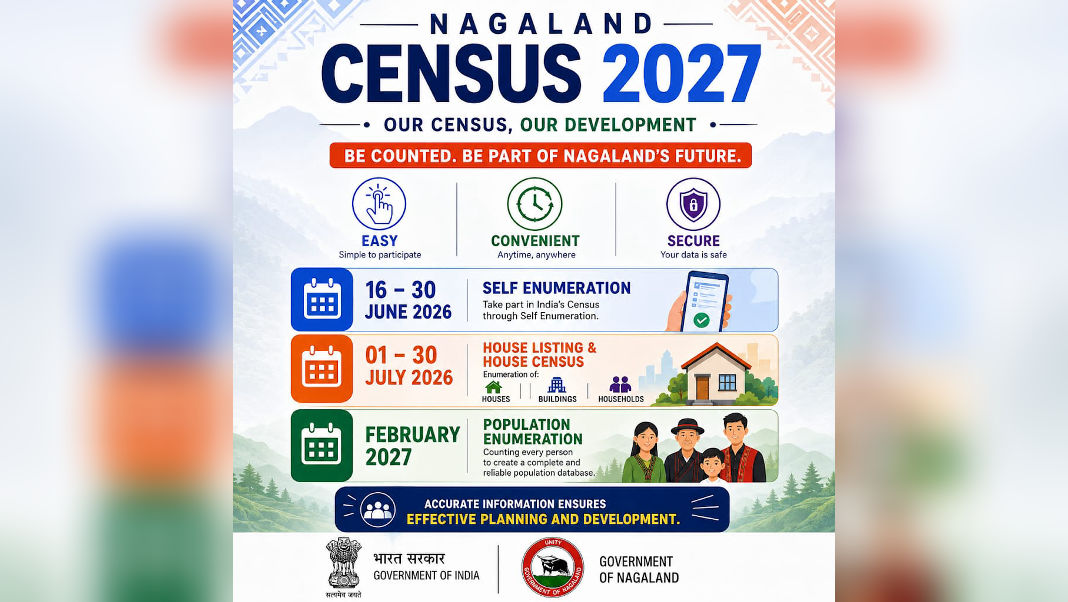

Kohima, June 29: Nagaland’s Census 2027 exercise has sparked a rush among many urban residents to enroll in their native villages amid fears over future delimitation and perceptions that higher population figures could bring more development funds.
The state has begun the first phase of Census 2027 with self-enumeration running from June 16 to June 30 through an online portal, marking India’s first digital census using self-enumeration and mobile applications. Door-to-door House Listing and Housing Census (HLO) will begin on July 1.
Officials say 6,134 census personnel have been deployed to cover the state’s 17 districts, 118 sub-districts, 39 statutory towns, five census towns and 1,606 villages.
The census has come under intense public scrutiny because of Nagaland’s troubled census history. The state recorded an “abnormally high” population growth of 64.53 per cent in 2001, followed by a negative growth of -0.58 per cent in 2011, making it the only state in the country to register an absolute decline in population since Independence.
Two issues are driving the present rush to villages. The first is the fear that villages could lose political representation when delimitation of Assembly constituencies is eventually undertaken after 2031. The second is the government’s awareness slogan, “Our Census, Our Development”, which many people interpret as meaning that future development funds will depend on village population figures.
Ground reports suggest that some people residing in urban centres such as Dimapur and Kohima are building houses in their native villages with the intention of getting themselves counted there.
However, census officials have repeatedly stressed that people should enroll at their usual place of residence. The self-enumeration guidelines require residents to provide the exact location of their residence on a digital map.
Director of Census Operations Kenie Miachieo has warned that furnishing false information is punishable under the Census Act, 1948, while assuring that all data collected will remain confidential.
Officials also say safeguards such as geo-tagging, unique self-enumeration IDs and digital mapping have been introduced to prevent duplication and improve accuracy.
Despite these measures, concerns remain over possible double counting and the risk of artificial depopulation of urban centres if large numbers of residents choose to be counted in their native villages.
The state government has launched awareness campaigns through various media platforms and is conducting training programmes for enumerators and supervisors ahead of the July 1 house-listing exercise.
For Nagaland, Census 2027 is more than a routine headcount. It is an opportunity to correct decades of disputed population figures and restore confidence in official statistics. Whether the state achieves an accurate count will depend on people following the rules and enumerators ensuring that every resident is counted only once and at the right place.