



Shillong, Nov 14: When the people of Nongpyrdi — a quiet village tucked deep inside Mawkynrew Block of East Khasi Hills — began to notice their once-dependable river shrinking, they didn’t wait for outside help. Instead, they turned to a solution rooted in their land, their knowledge, and their collective will: planting banana trees to bring the water back.
With a population of just 463 people, Nongpyrdi is a village where life revolves around the land. Families tend to their kitchen gardens filled with local vegetables and wild edibles like Jamyrdoh (Chameleon plant) and Jali (Gynura). Many depend on betel leaf cultivation for income, alongside traditional crops like beans, taro, garlic chives, cucumber, and chillies. Here, food, forest and water are intertwined — and when one begins to falter, the whole system feels the strain.

That strain became impossible mnore during a People’s Perspective Landscape Management Plan (PPLMP) session facilitated by NESFAS(North East Society for Agroecology Support). As the community mapped its natural resources — forests, water sources, wild edible plants, farming systems — a worrying truth emerged: Wah Umsot, the village’s lifeline, was in trouble.
For generations, Wah Umsot has supplied water for drinking, washing and daily life. But recent years have brought a steady decline in water levels, especially in winter. Community members noticed that the riverbank was thinning — fewer trees, less vegetation, and more exposed soil. Reduced forest cover meant less groundwater retention, triggering a slow but dangerous drop in water flow.
The villagers discussed the causes openly. Population growth had led to more land being cleared for shifting cultivation. Privately-owned plots meant no binding restrictions on tree-cutting. Gradually, the forest buffer around Wah Umsot had disappeared.
Recognising the urgency, Nongpyrdi’s women and members of the Biodiversity Management Committee (BMC) took the first step. On August 16, 2025, armed with saplings and determination, they planted 80 banana trees along the riverbank.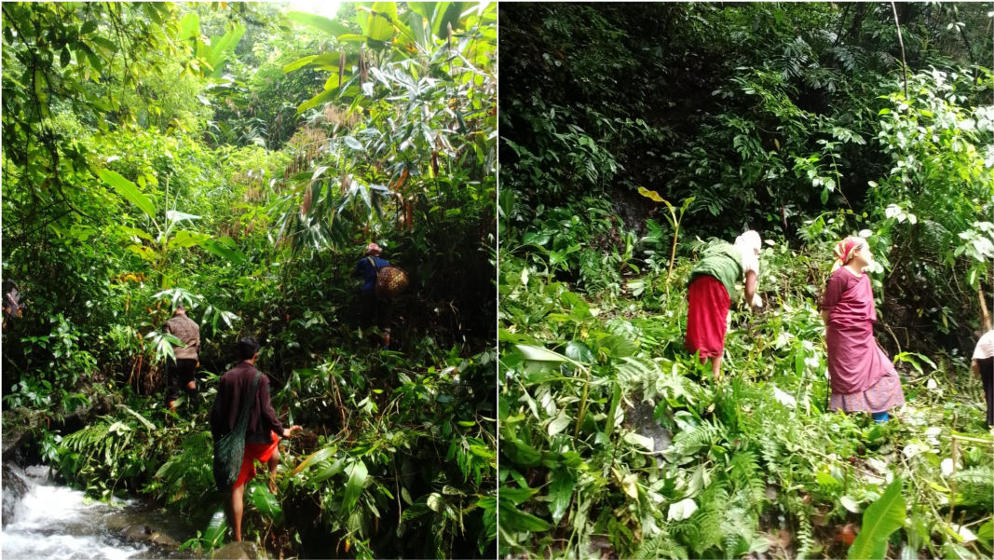
These weren’t just any saplings. The varieties — kait rem and kait san — are native banana species known for their dense root systems, which help retain soil moisture and stabilise riverbanks. They also bear fruit, offering both ecological and nutritional value.
The plantation was more than an environmental intervention; it was a declaration of collective responsibility. BMC members have already scheduled regular visits to monitor the growth of the saplings and ensure proper aftercare.
“For the past few months, we have been working with the community, and they have demonstrated strong interest in our initiatives,” said Naphishisha Nongsiej, Associate at NESFAS. “Their commitment to collaborate in protecting the environment and managing resources sustainably for the future is inspiring.”

Headman Teilang Nongrum echoed the sentiment:
“Through discussions and mutual understanding, and with NESFAS’ guidance, we decided to plant banana trees along the riverbank. Many of them are growing well. We have agreed to continue following up and taking good care of them.”
The challenge ahead is clear. With most land in Nongpyrdi under private ownership, there is no formal restriction on clearing forest for cultivation. NESFAS and community leaders are now engaging with landowners to safeguard the trees along Wah Umsot and prevent further degradation.
Also Read: Meghalaya Govt fixes uniform cement transport rate at Rs 9 per tonne-km
Also Watch
Find latest news from every corner of Northeast India at hubnetwork.in, your online source for breaking news, video coverage.
Also, Follow us on-
Twitter-twitter.com/nemediahub
Youtube channel- www.youtube.com/@NortheastMediaHub2020
Instagram- www.instagram.com/ne_media_hub
Download our app from playstore – Northeast Media Hub