

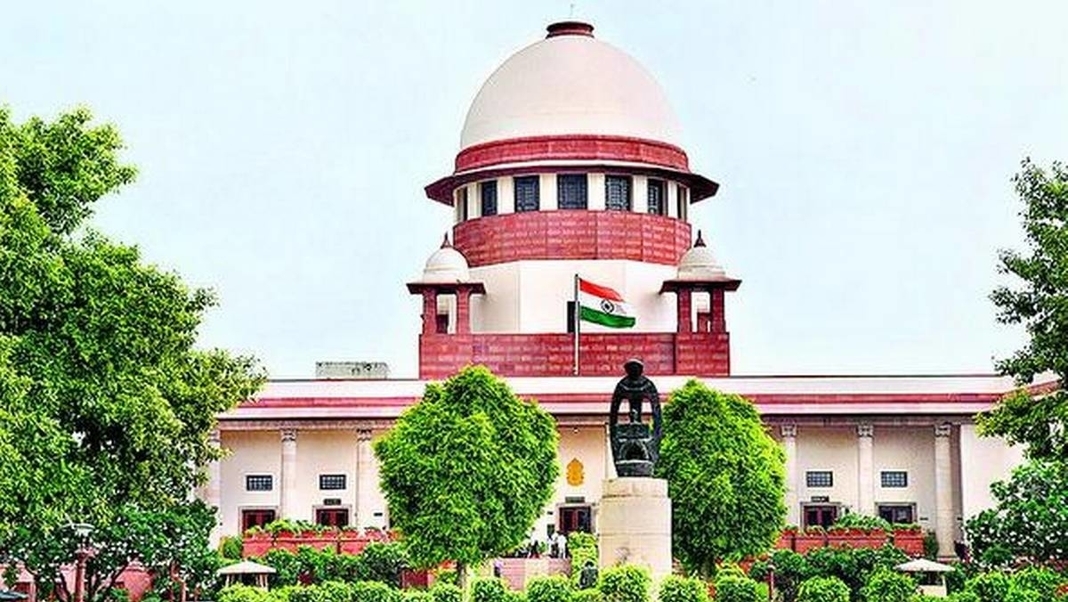

New Delhi, May 29: In one of its strongest interventions in judicial administration in recent years, the Supreme Court on Thursday directed High Courts across the country to pronounce reserved judgments within three months and ensure that bail orders are delivered without delay, seeking to end a long-standing problem that has left litigants waiting months and sometimes years for verdicts.
Invoking its extraordinary powers under Article 142 of the Constitution, the apex court issued binding directions aimed at tackling delays in reserved judgments, a practice it has repeatedly criticised for undermining public confidence in the justice delivery system.
The court made it clear that justice cannot remain in limbo indefinitely after hearings have concluded.
Under the new directions, all High Courts must pronounce reserved judgments within three months of reserving orders. If a verdict remains pending even after four months, litigants will have the right to approach the Chief Justice of the concerned High Court seeking reassignment of the matter.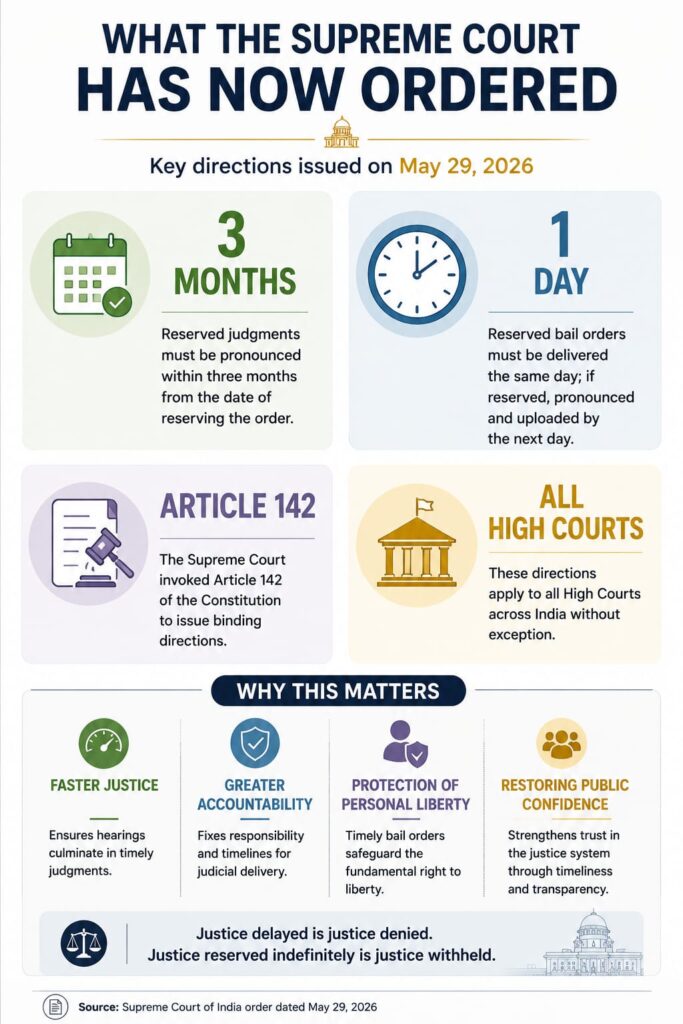
The Supreme Court also laid down strict timelines for bail cases, stressing that matters involving personal liberty cannot be subjected to prolonged delays. Bail pleas should ideally be decided on the same day they are heard.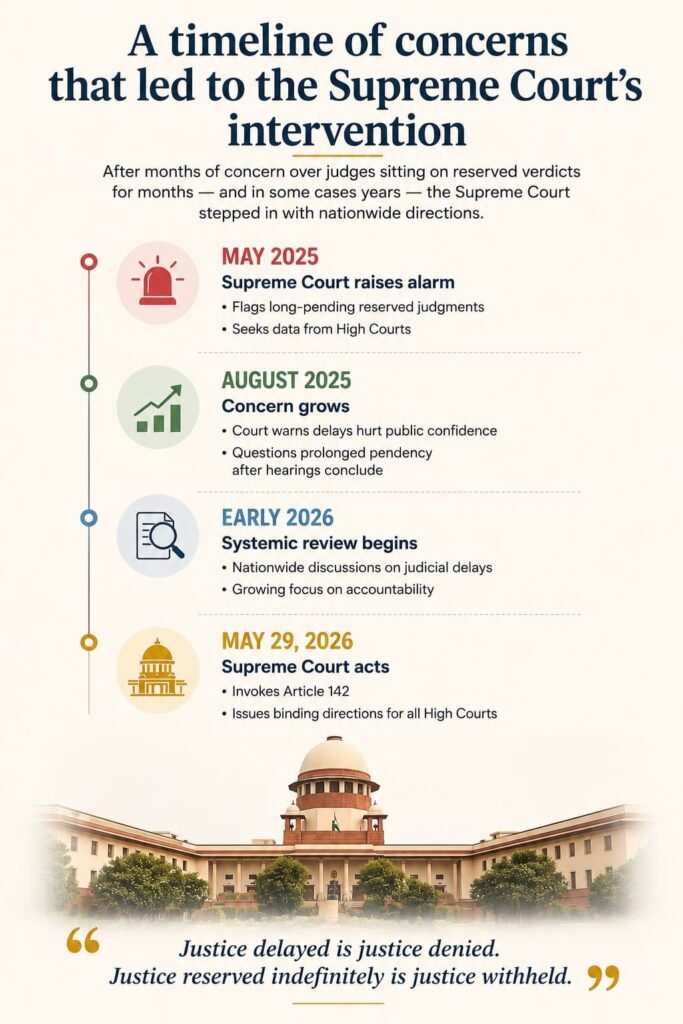
If an order is reserved, it must be pronounced and uploaded no later than the following day.
The landmark directions come after months of growing concern within the judiciary itself over judges reserving verdicts for prolonged periods. In 2025, the Supreme Court had sharply criticised the practice, remarking that some orders appeared to be reserved “for eternity” and warning that such delays strike at the heart of the constitutional promise of speedy justice.
The issue has increasingly come under scrutiny as litigants, lawyers and legal experts highlighted cases where arguments had concluded but judgments remained pending for months or even years, creating uncertainty and eroding faith in the judicial process. The Supreme Court had earlier sought data from High Courts on long-pending reserved judgments and had been examining mechanisms to improve accountability and transparency.
Legal observers say the latest order could have far-reaching implications for court functioning across India. Beyond reducing delays, it is being seen as an attempt by the country’s highest court to address a problem within the judiciary itself and restore confidence that hearings will culminate in timely decisions rather than prolonged silence.
The ruling is expected to be closely watched across the legal fraternity, particularly at a time when judicial reforms, case backlogs, delayed verdicts and prolonged bail hearings remain among the biggest challenges facing India’s justice delivery system.
Also Read: IAF aircraft being considered by Centre for NEET-UG retest paper transport after leak outrage
Also Watch
Find latest news from every corner of Northeast India at hubnetwork.in, your online source for breaking news, video coverage.
Also, Follow us on
Twitter-twitter.com/nemediahub
Youtube channel- www.youtube.com/@NortheastMediaHub2020
Instagram- www.instagram.com/ne_media_hub
Download our app from playstore – Northeast Media Hub