

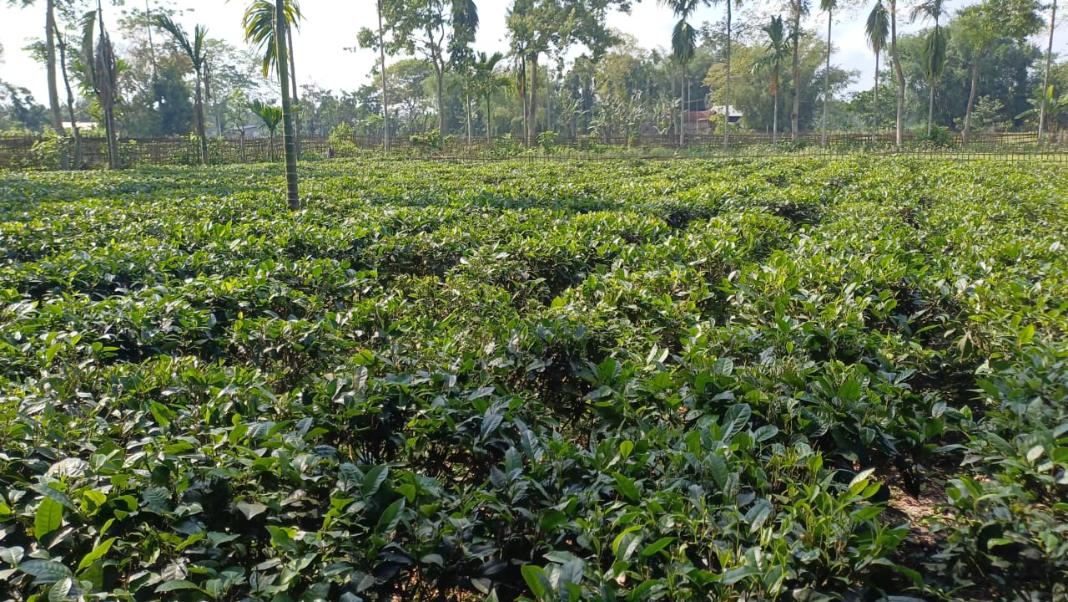

Guwahati, May 9: Known worldwide for its centuries-old Vaishnavite monasteries, vibrant satra culture and riverine landscape, Majuli may soon add another attraction to its identity — tea tourism.
The world’s largest inhabited river island, home to the neo-Vaishnavite institutions established by 15th–16th century saint-scholar Srimanta Sankardeva, has now its first registered tea garden, challenging long-held assumptions that tea could never grow on the Brahmaputra island’s sandy terrain.
In a breakthrough that challenges long-held beliefs about agriculture in Majuli, two brothers from the world’s largest river island have successfully established its first registered tea garden, turning what many considered impossible into reality.
Dulal Saikia and Tilak Saikia, founders of Chenimai Tea Garden, have become pioneers of tea cultivation in Majuli — a region better known for its neo-Vaishnavite monasteries, flood-prone landscape and sandy soil deposited by the Brahmaputra.
For decades, locals believed tea could never grow in Majuli because of the island’s fragile riverine terrain. But the brothers decided to test that assumption scientifically. After conducting soil analysis through the Assam Agricultural University in Jorhat, the results revealed that Majuli’s clay-rich layers could, in fact, support tea cultivation.
Encouraged by the findings, the duo planted their first tea saplings on September 27, 2021 — World Tourism Day — with a vision to combine sustainable farming with Majuli’s growing tourism economy.
Their persistence has now paid off. In 2025, the Tea Board of India officially registered Chenimai Tea Garden, making it Majuli’s first recognised tea estate.
“We started the initiative in 2020 by planting seeds and saplings and nurturing them with care. On World Tourism Day in 2021, we formally established the tea garden, and in 2025 it received Tea Board registration as Majuli’s first tea garden,” said Dulal Saikia.
He recalled the challenges they faced in the early years, from skepticism to environmental difficulties.
“Many believed tea could not be cultivated in Majuli because of the sandy soil, but we proved it was possible. Our efforts can inspire more farmers in Majuli to explore tea cultivation,” he said.
The brothers are now preparing to expand the plantation to over three bighas and are developing infrastructure for future growth.
The development adds a new dimension to Majuli’s identity. Alongside its globally recognised cultural heritage, the river island may now begin carving a place for itself on Assam’s tea map as well.
Also Read: Shillong to mark 55 years of world’s longest-running Bob Dylan tribute
Also Watch
Find latest news from every corner of Northeast India at hubnetwork.in, your online source for breaking news, video coverage.
Also, Follow us on-
Twitter-twitter.com/nemediahub
Youtube channel- www.youtube.com/@NortheastMediaHub2020
Instagram- www.instagram.com/nemediahub