

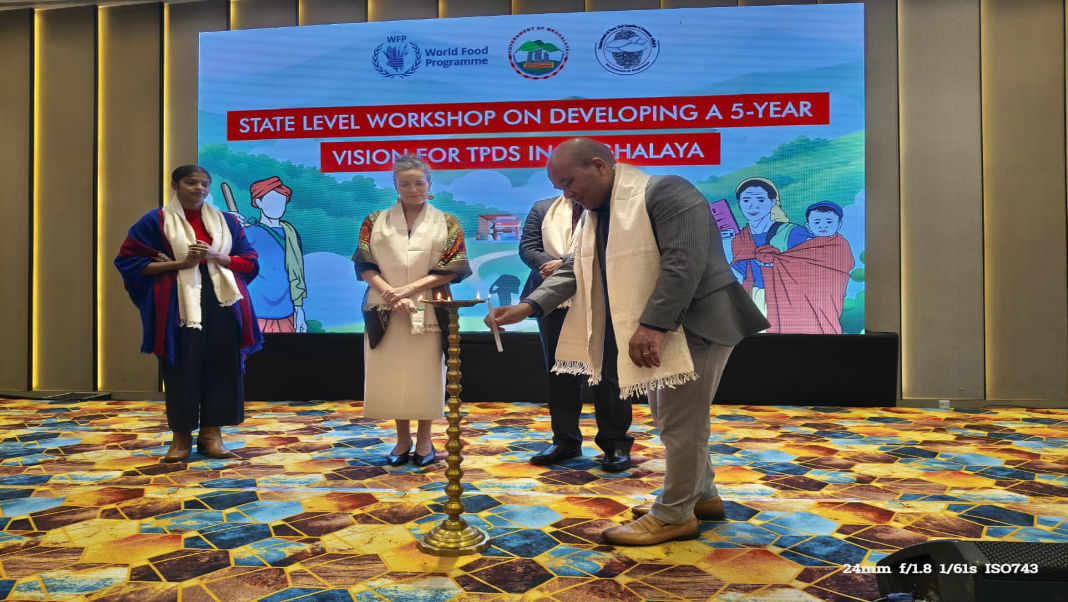

SHILLONG, NOV 20: The state government has decided to come up with five-year vision plan for the targeted public distribution system (TPDS) in the state.
The decision was taken at a state-level workshop organized by the Department of Food, Civil Supplies, and Consumer Affairs (FCS&CA) in collaboration with the United Nations World Food Programme (WFP).
The TPDS is a crucial instrument in Meghalaya’s efforts to achieve Sustainable Development Goal (SDG) 2: Zero Hunger.
This vision seeks to strengthen the state’s food security programmes, which provide entitlements to over 21 lakh people—roughly 80 per cent of the population.
Chairing the workshop, Minister in-charge Food Civil Supplies & Consumer Affairs Methodius Dkhar said, “Ensuring food security for every resident of Meghalaya, especially those in our most remote and vulnerable communities, remains our top priority. This workshop marked a vital step in collaborating with partners like WFP to develop a forward-looking, inclusive plan for TPDS. By adopting digital reforms and evidence-based strategies, we committed to building an efficient and accountable distribution system that left no one behind.”
Representative and Country Director, World Food Programme India Elisabeth Faure said, “The Government of Meghalaya’s vision for a modern, equitable public distribution system set a benchmark for the region. WFP was proud to support this transformative journey. Through a participatory and data-driven approach, we hope to support Meghalaya demonstrate how supply chains and safety nets could work better for every household, ensuring food and nutritional security for all.”
The workshop established a coherent vision, strategic priorities, and reform pathways for TPDS, aligning them with national frameworks and SDG targets.

It improved institutional convergence by linking TPDS with sectors such as nutrition, agriculture, livelihoods, and rural development.
A detailed roadmap was developed, outlining clear timelines, roles, responsibilities, and monitoring measures to ensure effective implementation. Additionally, lessons from field experiences were discussed, performance gaps analysed, and actionable ideas generated to promote systemic transformation.
The collaborative strategic vision and actionable plan are expected to set a new strategic direction, accelerate reforms for greater impact and equity for over three million residents, serve as a replicable model for other northeastern states facing similar challenges, and directly improve service delivery.
Also Read: Rediscovering Syiar Markasa: Meghalaya’s indigenous chicken enters scientific spotlight
Also Watch
Find latest news from every corner of Northeast India at hubnetwork.in, your online source for breaking news, video coverage.
Also, Follow us on-
Twitter-twitter.com/nemediahub
Youtube channel- www.youtube.com/@NortheastMediaHub2020
Instagram- www.instagram.com/ne_media_hub
Download our app from playstore – Northeast Media Hub

 in the state.)