

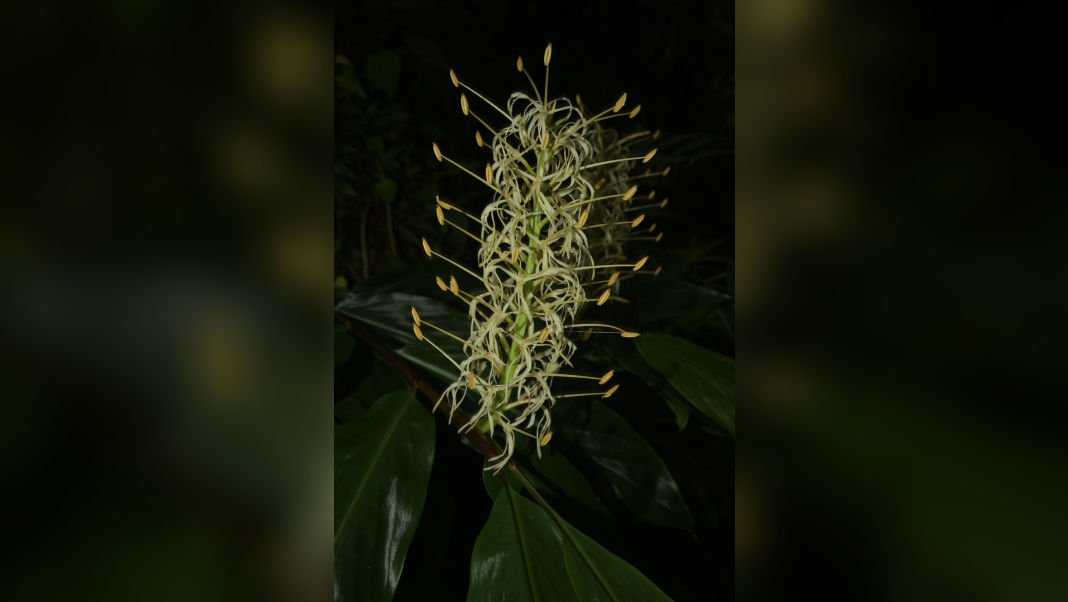

The fragrant ginger lily, newly identified in Shillong, honours the Assamese icon’s cultural legacy and environmental advocacy.
Shillong, July 22: A new species of ginger lily discovered in Shillong has been named after Meghalaya-born Assamese music legend Zubeen Garg, honouring his immense contribution to Indian culture and his long-standing advocacy for nature conservation.
The new species, Hedychium zubeengargianum, was identified by botanists at the Botanical Survey of India (BSI), Eastern Regional Centre, Shillong, after years of studying an unusual plant growing in the institute’s botanical garden. The discovery has been published in the latest issue of the journal Phytotaxonomy.
The researchers stumbled upon the plant during routine maintenance of the BSI garden. Although it had been growing there since at least 2018, its original source could not be traced because no collection records were available. Detailed morphological studies over several years eventually confirmed that it represented a species new to science.
In the paper, the authors said the species was named after Zubeen Garg “in recognition of his decades of cultural contribution to India and his vocal advocacy for nature conservation.”
Popularly known as ginger lilies, Hedychium species are among the Northeast’s most striking flowering plants. India is home to about 41 taxa, most of them occurring in the biodiversity-rich landscapes of the Northeast and the Western Ghats.

The newly described species stands apart from its closest relative, Hedychium gracile, by its creamy-white fragrant flowers, yellow anthers, densely hairy flowering stalk and an earlier flowering season from April to May.
The discovery reinforces Northeast India’s reputation as one of the country’s richest centres of plant diversity, where botanists continue to identify species previously unknown to science.
The study was authored by Dilip Kumar Roy, Rikertre Lytan and Nripemo Odyuo. So far, Hedychium zubeengargianum is known only from the Botanical Survey of India garden in Shillong, and researchers hope future surveys will reveal its natural habitat in the wild.