

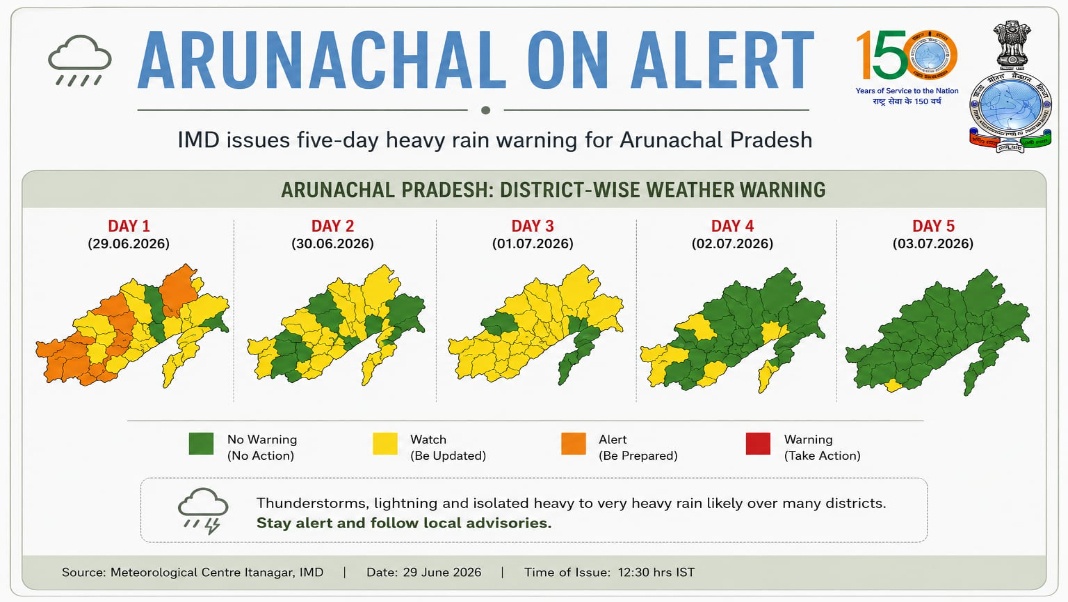

After a deadly landslide struck in Arunachal Pradesh, the India Meteorological Department (IMD) has warned of heavy rain, landslides and flash floods across parts of the Northeast over the next five days.
Guwahati, June 29: Less than 24 hours after an Assam worker died in a devastating landslide in Arunachal Pradesh’s fragile Himalayan terrain, fresh weather forecasts from the India Meteorological Department (IMD) suggest that several parts of the Northeast may still be exposed to serious risks.
The latest district-wise weather maps and hydrometeorological bulletins issued by the IMD indicate that parts of Arunachal Pradesh, along with vulnerable districts in Assam and Meghalaya, remain under the threat of heavy rainfall, flash floods and landslides in what could be one of the most critical phases of this year’s monsoon.
Rupam Rabha, 35, a Poklen machine operator from Boko in Assam’s Kamrup district, was buried when a massive landslide struck the Walong area of Arunachal Pradesh on Sunday night. His death has once again highlighted the dangers of working and travelling through the region’s unstable mountain terrain during the monsoon.
The district-wise warning maps issued by the Meteorological Centre, Itanagar, place several districts of Arunachal Pradesh under yellow (“Be Prepared”) and orange (“Take Action”) alerts on Day One of the forecast. Although the weather system is expected to gradually weaken over the coming days, the immediate risk of heavy rain, thunderstorms, lightning and localised landslides remains high in many districts.
The rainfall probability forecast for the next 24 hours also points to widespread rainfall across large parts of Arunachal Pradesh, with scattered to fairly widespread precipitation likely before conditions begin to ease later in the week.
Hydrological forecasts further reinforce the concern.
According to the latest Hydromet Bulletin issued by the Flood Meteorological Office (FMO), Itanagar, several river basins in Arunachal Pradesh are expected to continue receiving substantial rainfall. The Subansiri basin is likely to receive between 51 mm and 100 mm of rainfall over the next 24 hours, while the Dehang, Lohit and Dibrugarh river basins are also expected to receive significant rainfall.
The IMD’s latest Flash Flood Risk Outlook has identified several districts in Arunachal Pradesh, Assam and Meghalaya as being under moderate flash flood risk over the next 24 hours. The vulnerable districts include Changlang, Dibang Valley, East Kameng, Lower Subansiri, Papum Pare, Tirap, West Kameng, Anjaw and Kurung Kumey in Arunachal Pradesh; Baksa, Chirang, Kokrajhar and North Cachar Hills in Assam; and East Khasi Hills, West Khasi Hills and Jaintia Hills in Meghalaya.
The concern is not limited to intense cloudbursts alone. The IMD notes that surface runoff and inundation are likely in low-lying areas and places where soils are already fully saturated. In such conditions, even moderate rainfall can trigger landslides because hillsides weakened by days of continuous precipitation become increasingly unstable.
The forecasts also warn of thunderstorms, lightning and isolated spells of very heavy rainfall, adding to the risks for travellers using mountain highways and workers engaged in infrastructure projects across the hill states.
Recent rainfall figures underline the intensity of the current monsoon spell. Pasighat recorded nearly 20 cm of rainfall during the past 24 hours, while Itanagar received around 8 cm and Tezpur about 6.5 cm, leaving large parts of the region waterlogged. The rainfall has once again exposed the vulnerability of highways winding through steep mountain slopes, where landslides, damaged bridges and disrupted connectivity become recurring challenges every monsoon.
Authorities have advised residents living near vulnerable hill slopes, rivers and low-lying areas to remain alert, avoid unnecessary travel during periods of intense rainfall and closely follow advisories issued by district administrations.
While the five-day forecast suggests that weather conditions could gradually improve towards the latter half of the week, meteorologists caution that saturated hill slopes often remain unstable long after the rain begins to ease. The immediate concern for the Northeast is therefore not just the rainfall itself, but the chain of hazards it leaves behind fragile hillsides, swollen rivers, disrupted roads and isolated communities.