


– Kenny Jyrwa
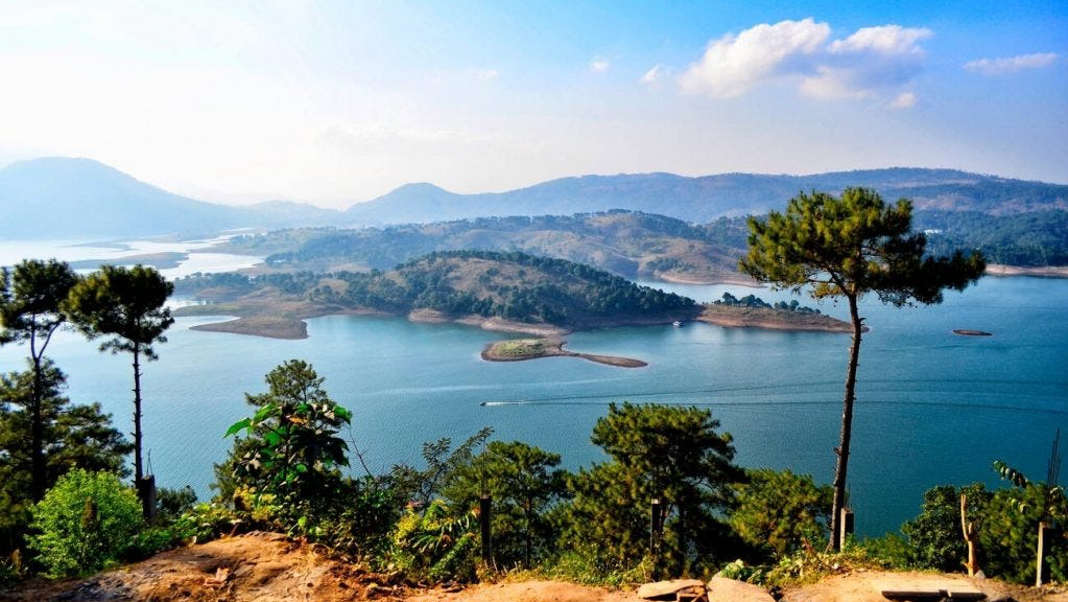
Few issues in recent weeks have stirred as much debate in Meghalaya as the proposed tourism project at Umiam, where the state government, in partnership with the Indian Hotels Company Limited (IHCL), plans to develop a Luxury 5 star Hotel facility. At the centre of this debate lies Lumpongdeng Island; an otherwise quiet, scenic stretch of land that has suddenly become a symbol of a much larger contest between development and dissent.
The facts, at least on paper, are straightforward. The proposed project spans roughly 66 acres, of which 36.10 acres fall on Lumpongdeng Island and 29.64 acres on the existing Orchid Lake Resort site. Crucially, the main hotel structure is planned at the Orchid site, not on the island itself, as per the government plan.
The government has also stated that only non-intrusive, temporary or seasonal structures would be permitted on Lumpongdeng, maintaining that environmental norms will be respected.
Yet, what began as an environmental concern has quickly escalated into a full-blown controversy. A group of protesting youths, positioning themselves as custodians of ecological preservation, has demanded that the entire project be scrapped. Their agitation, now intensified through an indefinite hunger strike, reflects a deep distrust of state-led development initiatives.
However, the trajectory of this protest raises uncomfortable questions. What started as a debate on environmental sensitivity appears to have been overtaken by political undertones. The involvement (direct or indirect) of opposition interests has shifted the discourse from one of scrutiny to outright rejection. The shift is telling: from concerns about ecological impact to calls for the government’s collapse. This is no longer just about Lumpongdeng.
To be clear, environmental concerns in a fragile landscape like Umiam are neither trivial nor dismissible. Lumpongdeng Island, accessible only by boat and known for its quiet, low-impact tourism such as the existing boathouse offering solar-powered accommodation which deserves careful consideration. Any development here must be measured, transparent and accountable.
But opposition, to be meaningful, must also be responsible. Blanket rejection without engagement risks undermining the very cause it seeks to defend. A “no talks, no compromise” approach is not democratic resistance however it is obstruction. If every project is treated as inherently illegitimate, governance itself becomes impossible.
This pattern is not new. Across sectors such as roads, hospitals, infrastructure and a necessity such as waste management projects have increasingly faced resistance that goes beyond scrutiny into reflex opposition. The consequence is a growing perception that development in Meghalaya is perpetually stalled, not always by policy failure, but by an inability to build consensus.
There is also an economic reality that cannot be ignored. Meghalaya’s structural challenges is limited industrial base, rising unemployment and heavy reliance on government jobs..are well documented. Tourism remains one of the few sectors with the potential to generate scalable growth. But tourism cannot thrive on natural beauty alone; it requires infrastructure, investment and services.
Blocking such investments carries tangible costs. Beyond direct employment in hospitality, projects of this scale create ripple effects. Why overlooked the benefit to drivers, tour guides, small vendors, maintenance workers and a host of informal sector participants. For a state where job opportunities remain scarce, these are not marginal gains.
It is also worth addressing the rhetoric that has emerged alongside the protests. Attempts to stigmatise professions within the hospitality and wellness sectors, including trained spa and massage practitioners, reflect a troubling distortion of facts. Such narratives do little to strengthen public discourse; instead, they risk alienating those whose livelihoods depend on these very industries.
At its core, the issue is no longer confined to a single project. It has evolved into a broader question: can Meghalaya pursue structured, accountable development while safeguarding its environment, or will it remain trapped in cycles of suspicion and stalled progress?
The government, for its part, has maintained that it is open to dialogue, reiterating that the project will adhere to eco-friendly, low-impact principles. That willingness to engage must be matched by an equal readiness from protestors to move beyond absolutist positions.
Meghalaya today stands at a critical juncture. One path leads towards calibrated development where investment, environmental safeguards, and public accountability coexist. The other leads towards persistent gridlock, where projects are halted before they begin, and opportunities quietly slip away.
There is, in reality, little room for a middle ground.
Development is not inherently the enemy. Misinformation and mistrust, however, can be. A state cannot move forward if every initiative is met with default resistance, just as it cannot progress if genuine concerns are ignored.
The challenge, therefore, is not choosing between development and preservation, it is ensuring that one does not come at the cost of the other.
Also Read: Hek offers BJP ticket to former Meghalaya CS DP Wahlang for Shillong LS bypoll
Also Watch
Find latest news from every corner of Northeast India at hubnetwork.in, your online source for breaking news, video coverage.
Also, Follow us on
Twitter-twitter.com/nemediahub
Youtube channel- www.youtube.com/@NortheastMediaHub2020
Instagram- www.instagram.com/ne_media_hub
Download our app from playstore – Northeast Media Hub

, plans to develop a Luxury 5 star Hotel facility.)