

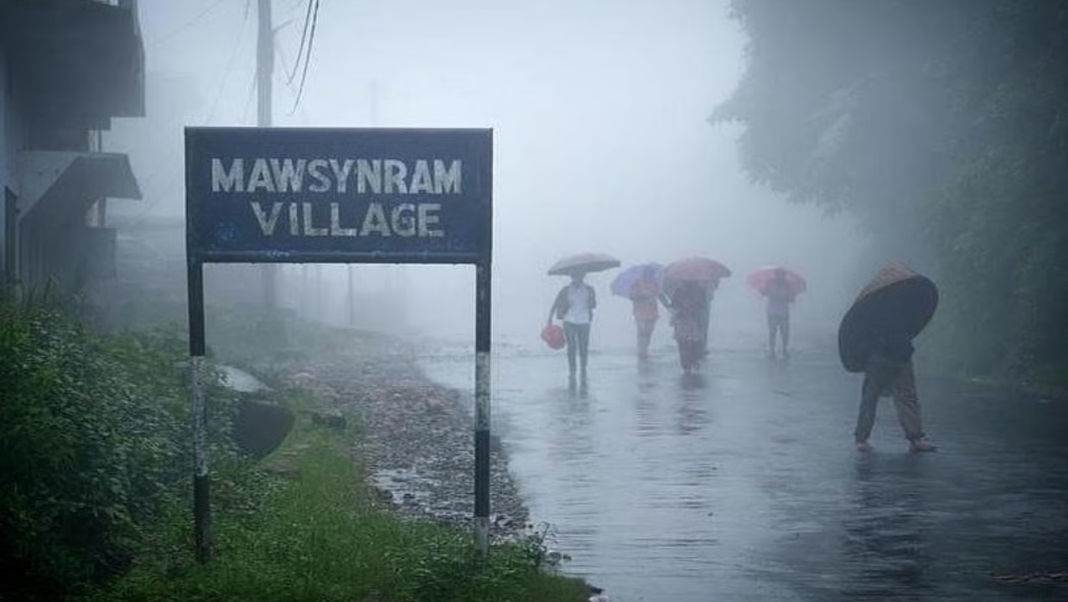

Guwahati, Dec 23: Air pollution may be quietly altering rainfall patterns in Mawsynram, the world’s wettest place, according to a new scientific study that links rising aerosol levels to a noticeable decline in rainfall across the region.
The study, published in the Journal of the Indian Society of Remote Sensing, was conducted by Mamta Devi, Sumit Kumar Mishra, Kartika Pandey, Supreet Kaur, Anikender Kumar, Vijay Kumar Soni, Amarendra Singh, and Atul Kumar Srivastava
Using satellite observations and rainfall data from 2014 to 2023, the researchers examined long-term changes in atmospheric aerosols—tiny airborne particles produced by sources such as biomass burning, vehicle emissions, and pollution transported from other regions—and their impact on clouds and precipitation over Mawsynram.
Atmospheric aerosols significantly impact the Earth’s climate by interacting with solar radiation and cloud microphysics, contributing to phenomena like radiative forcing, cloud albedo changes, and precipitation variability.
The study found that aerosol levels over Mawsynram have increased by about 14.6% over the last decade. During the same period, annual rainfall declined by nearly 14%, dropping from 10,235 mm in 2014 to 8,838 mm in 2023.
According to the authors, the relationship between pollution and rainfall is statistically significant. “A notable decline in regional annual rainfall, from 10,235 mm to 8,838.2 mm over the past decade, with a significant negative correlation (r = −0.615) with aerosol optical depth, underscores the intricate interactions between aerosols and local climatic patterns,” the study states.
The researchers explain that higher aerosol concentrations lead to the formation of smaller cloud droplets, which delays their ability to merge into larger raindrops. “Higher fine-mode aerosol concentrations may inhibit cloud formation by delaying droplet coalescence,” the authors note.
This process, known as the aerosol indirect effect, can suppress rainfall even in moisture-rich environments like Meghalaya. The study found that increased aerosols were associated with reduced cloud droplet size and changes in cloud properties, making rainfall less efficient.
The impact was strongest during the pre-monsoon and winter seasons, when aerosol levels were highest. The researchers observed that aerosol optical depth rose steadily by about 0.007 per year, while fine particles became more dominant in the atmosphere.
In addition to affecting rainfall, aerosols were found to alter the region’s energy balance. The study reports rising atmospheric heating rates, with winter heating increasing from 0.4 to 0.6 K per day and pre-monsoon heating from 0.5 to 0.7 K per day over the decade. This warming occurs alongside reduced sunlight reaching the surface, a phenomenon known as surface dimming.
“These results highlight the complexity of aerosol–cloud–rainfall interactions in a climatically sensitive region like Mawsynram,” the authors write, adding that such interactions are often underestimated in climate models.
The authors note that given that Mawsynram is the wettest place on Earth, these insights hold importance beyond the local scale, offering valuable perspectives on global hydrological and climatic processes.