

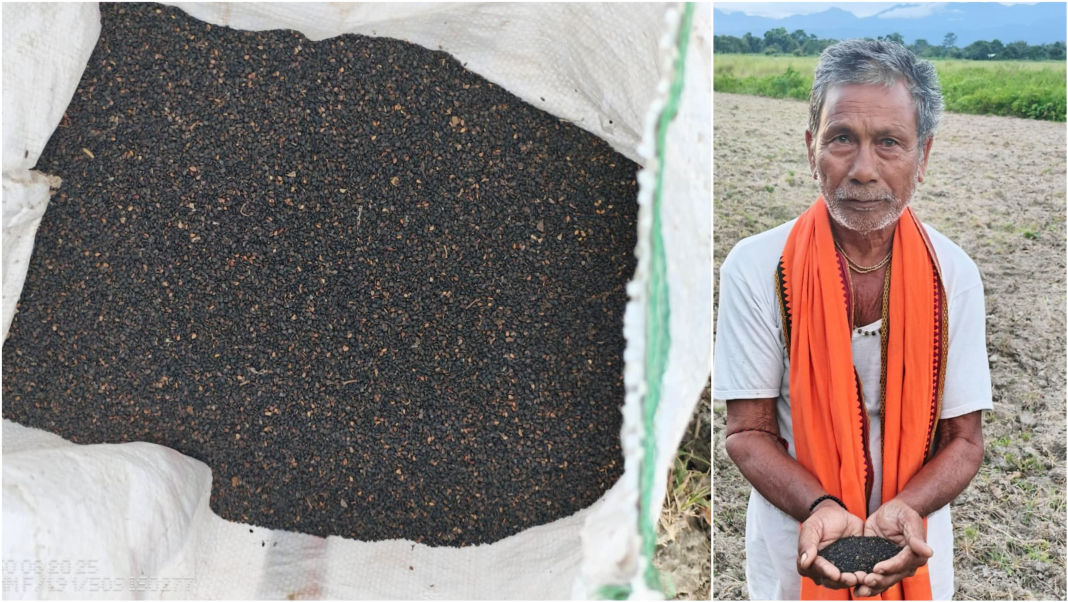

Guwahati, Aug 29: In Assam’s Udalguri and Baksa districts, where farmlands often face raids by wild elephants, farmers are being encouraged to grow sesame as a safer alternative to paddy.
Biodiversity conservation organisation Aaranyak, with support from the SBI Foundation, has started distributing sesame seeds to households in areas badly affected by human-elephant conflict (HEC). Three families from Sathgharia villages in Udalguri recently received 7.5 kilograms of seeds, while two families in Madhupur Mainaguri, Baksa, received 6.5 kilograms.
Udalguri and Baksa are two of the most severely affected districts in Assam in terms of human-elephant conflict (HEC). The majority of people in these two districts are entirely dependent on agriculture, particularly paddy cultivation, for food and income. However, shrinking forest resources and habitat degradation in these districts have forced elephants to increasingly raid croplands, with paddy fields being among their prime targets.

A government-backed study, “Elephant Human Conflict in the State of Assam (2000-2023): Trends, Challenges, and Insights” by the Wildlife Institute of India and Project Elephant, reveals that between 2000 and 2023, 1,209 elephants died in Assam, with over half of the deaths resulting from direct human causes. During the same period, human-elephant conflict claimed 1,468 human lives and left 337 injured, making Assam one of the most dangerous hotspots for such encounters globally.
The report, based on 23 years of forest department records and land-use analysis across 21 forest divisions, paints a grim picture. Habitat loss, rapid agricultural expansion, and infrastructure growth are driving elephants and humans into increasingly perilous proximity.
Recurrent conflicts result in devastating losses for farmers, aggravating their already fragile livelihoods while simultaneously elevating tensions between people and elephants.
“The rise in conflicts is directly tied to deforestation, expanding human settlements, and the lure of high-energy crops like paddy,” the report states.
Sesame, on the other hand, is not a preferred food for elephants. “This makes it a more reliable option for farmers, helping them secure their incomes and lowering the risk of direct encounters with elephants”, an Aaranyak official said.
The distribution was facilitated by Aaranyak staff members Mondeep Basumatari, Abhijit Saikia, Jaugashar Basumatary and Pradip Barman, who also engaged with the families to ensure better understanding of the initiative.
By promoting such alternative crops, Aaranyak aims to reduce conflict, safeguard livelihoods, and support peaceful coexistence between people and elephants.
Also Read: Assam records sharp decline in crime, surge in convictions: CM Sarma
Also Watch
Find latest news from every corner of Northeast India at hubnetwork.in, your online source for breaking news, video coverage.
Also, Follow us on-
Twitter-twitter.com/nemediahub
Youtube channel- www.youtube.com/@NortheastMediaHub2020
Instagram- www.instagram.com/ne_media_hub
Download our app from playstore – Northeast Media Hub