

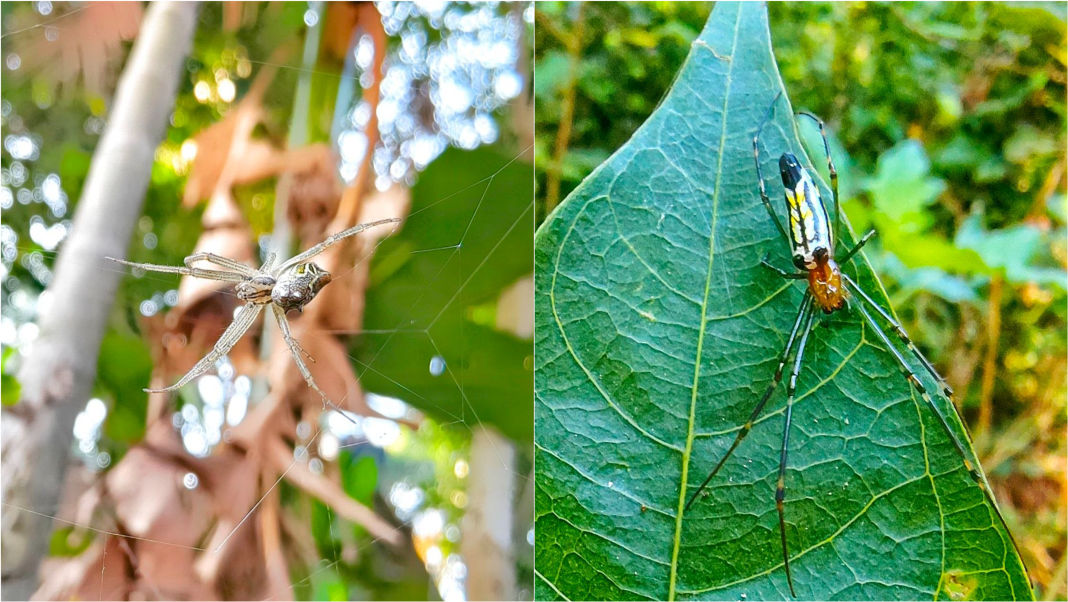

Guwahati, Sep 16: A team of Indian scientists has documented 28 species of orb-weaving spiders from Meghalaya’s Khasi Hills, highlighting the state’s rich biodiversity and the ecological importance of these little-known predators.
The year-long survey, conducted by researchers from the Zoological Survey of India (ZSI), covered both the East Khasi Hills and the West Khasi Hills. It revealed that spiders belonging to 16 genera and two families—Araneidae (19 species) and Tetragnathidae (9 species)—inhabit the forests of the region. Among them, two species stood out for their dominance: Argiope pulchella and Leucauge celebesiana.
Orb-weaving spiders (family Araneidae and related groups) are best known for their iconic wheel-shaped webs, called “orb webs.” These webs, designed with precision, are used to capture flying insects such as moths, flies, and mosquitoes. By serving as natural pest controllers, orb-weavers play a key role in maintaining ecosystem balance. Unlike hunting spiders that actively chase their prey, orb-weavers rely on patience, letting their intricate silk traps do the work.
The study, published in Records of the Zoological Survey of India, recorded that spider abundance varied across seasons. The monsoon months (June–August) had the highest number of individuals (43%), followed by post-monsoon (31%) and pre-monsoon (26%). The researchers link this trend to increased humidity during the rainy season, which helps in web construction and maintenance.
Interestingly, the West Khasi Hills hosted greater species richness compared to the East Khasi Hills. This may be due to denser vegetation and lower levels of human disturbance in the western region.
According to the authors—Arup Chanda, Supradipta Dutta, Rajib Goswami, Shouvik Mali, Souvik Sen, and Dhriti Banerjee—the findings highlight not just the diversity of spiders but also their value as bio-indicators. Because spiders are sensitive to environmental changes, their presence and abundance can signal the overall health of an ecosystem.
“High diversity of orb-weavers reflects the ecological vitality of these forests. It also opens up the scope for future discoveries from unexplored areas of Meghalaya,” the researchers noted.
Despite being part of the global Indo-Burma biodiversity hotspot, the spiders of Meghalaya remain poorly studied. The authors warn that anthropogenic pressures—such as deforestation and habitat fragmentation—pose threats to these vital species.
This pioneering study, the first detailed account of orb-weaving spiders from the Khasi Hills, not only expands scientific knowledge but also emphasises the urgent need to conserve Meghalaya’s fragile forest ecosystems.
Also Read: Child Rights Commission urges swift Action in murder of four-year-old in Nongrah
Also Watch
Find latest news from every corner of Northeast India at hubnetwork.in, your online source for breaking news, video coverage.
Also, Follow us on-
Twitter-twitter.com/nemediahub
Youtube channel- www.youtube.com/@NortheastMediaHub2020
Instagram- www.instagram.com/ne_media_hub
Download our app from playstore – Northeast Media Hub