

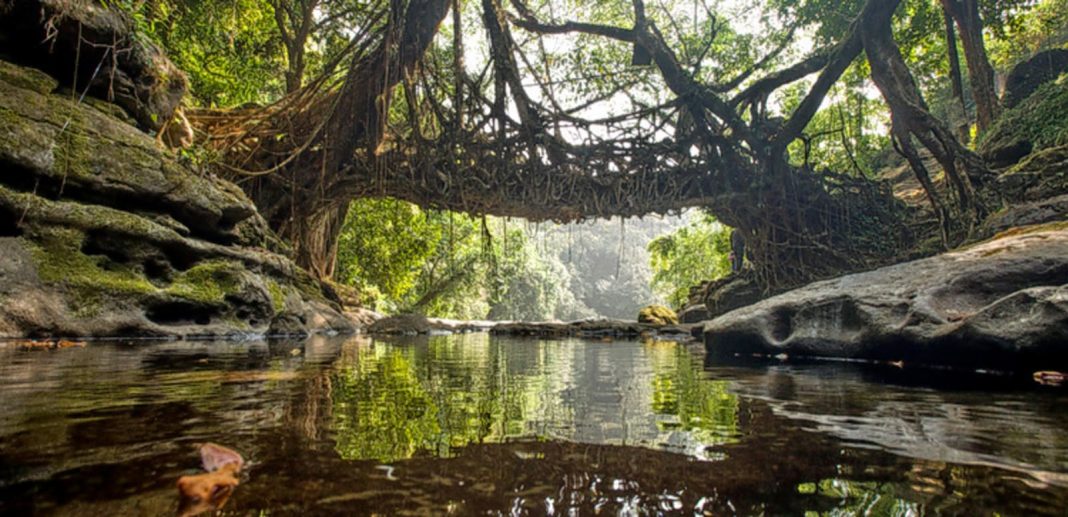

Guwahati, Oct 19: Meghalaya’s iconic Living-Root Bridges(LRB), grown from the aerial roots of Ficus elastica by the Khasi and Jaintia communities, are not only a marvel of indigenous engineering but also an increasingly important site for ecotourism. A new study has now put numbers to their recreational and cultural value, highlighting both their global appeal and the challenges of sustaining them for future generations.
Grown by indigenous Khasi tribal communities, these structural ecosystems have performed in extreme climatic conditions for centuries, and encapsulate a profound harmony between humans and nature. The underlying knowledge and skills have evolved through generations and continue to be practised today, affirming their exceptional value and relevance. Facilitating connectivity and disaster resilience in more than 75 remote villages in and near the wettest region on Earth, LRB validates the outstanding ingenuity and resilience of an ancient culture, where cooperation and reciprocity were the fundamental building blocks of life.
There is a nominal entry fee of Rs 30 for single-decker and for double-decker bridges, which helps maintain the bridges. The root bridges also generate positive externalities for the local population by creating various jobs (many young people provide service as tour guides) and a fairly sustainable market for hospitality services and local products
The research, conducted by Monica Konjengbam of the Forest Research Institute and Sanjay Singh of the Indian Council of Forestry Research and Education, Dehradun and published in New Forests Journal, employed a double-bound contingent valuation method (CVM) to estimate the willingness of tourists and local communities to invest in the bridges’ preservation.
Findings reveal that tourists are willing to pay an average entry fee of ₹154 per visit. Meanwhile, community members expressed willingness to dedicate an average of 14 days annually towards conservation efforts, underscoring a strong sense of stewardship rooted in tradition. Interestingly, the study found a gendered difference in voluntary participation, with male respondents more inclined than female respondents to contribute labour days.
“These values reflect the dual role of living-root bridges as both recreational assets and cultural bequests,” the authors noted, stressing that striking a balance between heritage conservation and tourism-driven livelihoods is essential.
The research also sheds light on visitor demographics. Among the 200 surveyed tourists, the largest proportions came from Assam (15.5%), West Bengal (15%), New Delhi (13.5%), and Nagaland (11.5%), alongside international visitors. The data underscores the bridges’ growing role as a pan-Indian and global ecotourism destination.
However, the rising influx of visitors raises pressing concerns. The study points out the urgent need to align tourist volume with the sites’ carrying capacity and consider a rational increase in entry fees to ensure sustainable management. Without such measures, the fragile root structures, maintained through meticulous community practices for centuries, could face degradation.
The living-root bridges, some of which are over 100 years old, are more than pathways across rivers—they embody an “unbroken stream of life” for the Khasi and Jaintia people, who have preserved and nurtured them since antiquity.
Also Read: Meghalaya Governor flags off skill development program for NE youth
Also Watch
Find latest news from every corner of Northeast India at hubnetwork.in, your online source for breaking news, video coverage.
Also, Follow us on-
Twitter-twitter.com/nemediahub
Youtube channel- www.youtube.com/@NortheastMediaHub2020
Instagram- www.instagram.com/ne_media_hub
Download our app from playstore – Northeast Media Hub

, grown from the aerial roots of Ficus elastica by the Khasi and Jaintia communities, are not only a marvel of indigenous engineering but also an increasingly important site for ecotourism.)