



High spending, falling mortality, and a shift toward preventive care signal a turning point.
ROOPAK GOSWAMI
Shillong, Feb 22: Is Meghalaya quietly scripting one of India’s most ambitious public health transformations? The newly released Meghalaya Health Atlas, prepared by the State Health Systems Resource Center (SHSRC), offers a detailed, data-driven snapshot of where the state’s health system stands today — and where it intends to be by 2030.
At the heart of the Atlas lies a strong fiscal message. Meghalaya allocates over nine percent of its state budget to health — among the highest in the country. The state’s per capita health expenditure stands at ₹7,690, more than double the national average of ₹3,169. Together, these figures suggest that healthcare has moved from the margins to the centre of governance in the hill state.
The Atlas documents notable gains in maternal and child health outcomes over the past five years. Between 2020 and 2025, maternal deaths declined by 57 percent, while infant deaths fell by 42 percent. These improvements are attributed to targeted interventions such as the Rescue Mission and the Chief Minister’s Safe Motherhood Scheme, which tackled long-standing barriers including transport constraints, lack of transit facilities, and limited community mobilisation.

However, district-level data reveals uneven performance. While the overall trajectory is positive, disparities persist across regions, indicating that sustained and localised efforts remain essential.
The disease profile outlined in the Atlas points to a shifting health burden. Circulatory diseases continue to be the leading cause of death, followed by neoplasms and digestive disorders. At the same time, the proportion of infant deaths attributed to perinatal conditions rose sharply from 58.73 percent in 2019 to 76.54 percent in 2023. The data suggests that even as communicable diseases remain relevant, non-communicable diseases and complications related to birth and neonatal health are becoming increasingly prominent.
In terms of infrastructure, Meghalaya currently has 16 district hospitals, 31 community health centres, 137 primary health centres, and 496 sub-centres as of 2024–25. While several facility norms are being met, the Atlas acknowledges gaps in newborn critical care infrastructure in certain districts. Human resource distribution and specialist availability continue to require focused attention.
Technology and innovation form a significant pillar of the state’s strategy. Drone delivery of medicines — first launched in West Garo Hills — has reduced delivery time from several hours by road to around 30 minutes in remote locations. The MOTHER App tracks every registered pregnancy in real time, enabling frontline workers and administrators to identify high-risk cases and intervene promptly. Meanwhile, under the Megha Health Insurance Scheme (MHIS), 93 percent of households are covered, with over ₹1,000 crore in financial protection delivered over 13 years. These initiatives reflect a deliberate shift from reactive treatment to preventive, promotive, and digitally enabled health governance.
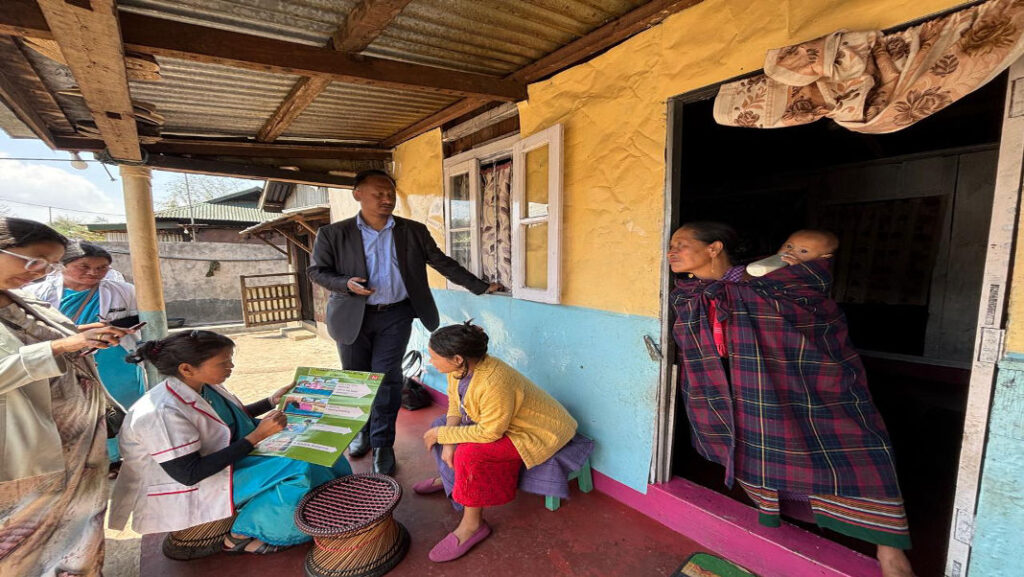
Perhaps the most ambitious aspect of the Atlas is its 2030 vision: reducing maternal deaths to fewer than 50 annually, bringing the Infant Mortality Rate below 10, and increasing life expectancy beyond 75 years. For a predominantly rural hill state, where nearly 79.4 percent of the population lives in rural areas, these goals represent a bold public health aspiration.
Principal Secretary, Health and Family Welfare, Dr. Sampath Kumar, notes that the Atlas brings together “credible data, spatial analysis, and system-level insights” to strengthen evidence-based decision-making across districts. Mission Director, National Health Mission, Ramakrishna Chitturi, says the state has adopted a “problem-driven and data-led approach” — from reducing maternal mortality to strengthening primary care and expanding financial protection through MHIS.
Dr. Valerie J. Laloo, State Nodal Officer of SHSRC, describes the Atlas as a move away from “fragmented data use towards integrated, spatially informed analysis.” She calls it not merely a report, but “an invitation to question patterns, test assumptions, and design better solutions” suited to Meghalaya’s unique context.
The Meghalaya Health Atlas is more than a compilation of statistics. It is a statement of intent — combining fiscal commitment, policy reform, community engagement, and technological innovation.
Also Read: Renewed push for Garo in Eighth Schedule
Also Watch
Find latest news from every corner of Northeast India at hubnetwork.in, your online source for breaking news, video coverage.
Also, Follow us on
Twitter-twitter.com/nemediahub
Youtube channel- www.youtube.com/@NortheastMediaHub2020
Instagram- www.instagram.com/ne_media_hub
Download our app from playstore – Northeast Media Hub

, offers a detailed, data-driven snapshot of where the state’s health system stands today — and where it intends to be by 2030.)