

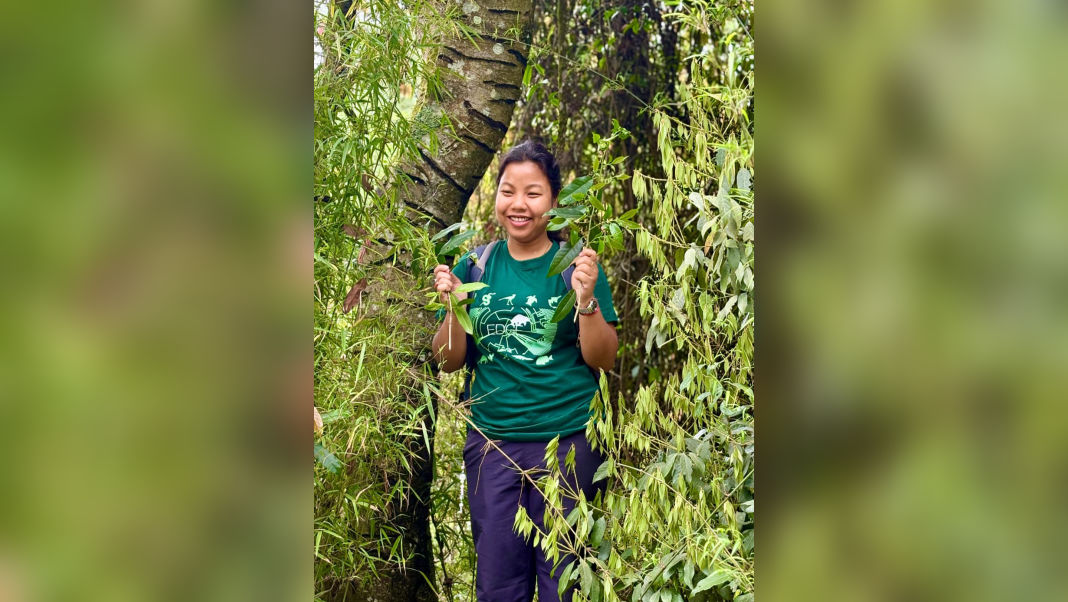

Guwahati, Aug 13: Assam-born conservationist Raktima Basumatary has embarked on a mission to save one of the world’s rarest and most evolutionarily unique trees — the Khasi Holly (Ilex khasiana) — found only in Meghalaya’s Khasi Hills.
Through her EDGE of Existence Fellowship, Basumatary’s project “Conserving Ilex khasiana in East Khasi Hills: A Study on Distribution, Threats and Community Awareness” will map the species’ shrinking range, assess threats to its survival, and mobilise local communities to safeguard its fragile habitat.

Critically Endangered and representing millions of years of evolutionary history, the Khasi Holly is on the brink due to habitat loss and human pressures. Basumatary’s approach combines rigorous field research with community-led conservation, turning local knowledge and stewardship into a lifeline for the species. It is an evergreen species growing up to 20 metres in height.
A forestry postgraduate from NERIST, she has previously worked on Asian elephant monitoring in the Kaziranga–Karbi Anglong Landscape and on forest carbon stock assessments in Assam. “I want to ensure that conservation is not just about science, but about people,” she said, emphasising the importance of giving communities a central role in protecting natural heritage.
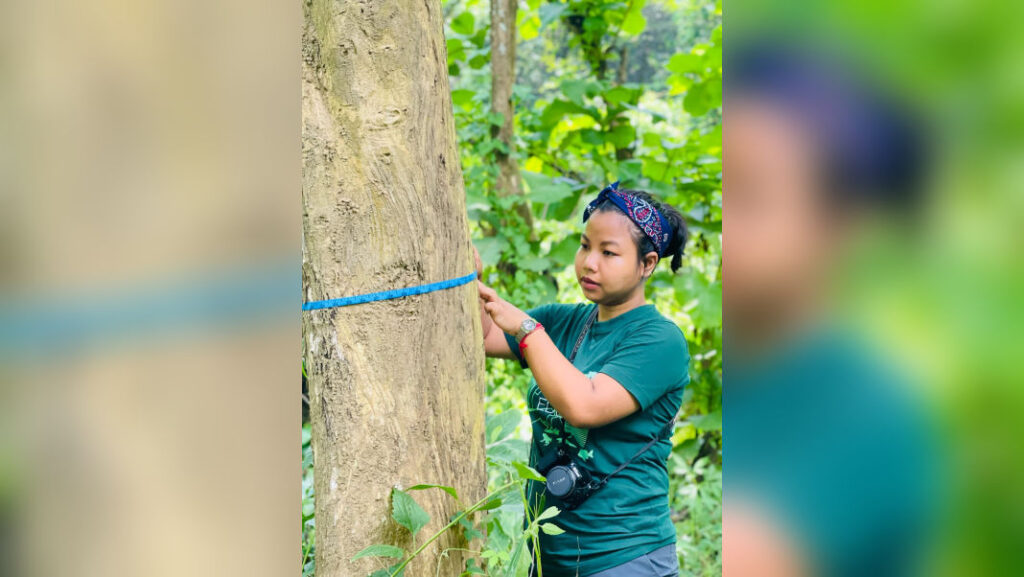
She spends time in the forests locating the last remaining stands of Khasi Holly, studying its threats, and engaging with local communities to understand how the plant is used in traditional medicine.
In Khasi traditions, extracts are used as antibacterial agents in tuberculosis and as antivirals for cold and fever, while in Mizo traditional medicine, the leaves treat bacterial and parasitic infections, cancer, and blood diseases. Although Khasi Holly is endemic to the Khasi Hills of Meghalaya, a small population has been documented in a localized area of Aizawl, Mizoram.

Although classified as Critically Endangered more than 20 years ago, the species remains poorly studied, with little information on its distribution, population trends, and threats. Basumatary’s two-year project aims to fill these gaps by mapping its range, reassessing its conservation status, identifying threat hotspots, and holding workshops and outreach programmes — from schools to forest departments — to lay the groundwork for long-term protection.
The EDGE of Existence programme, run by the Zoological Society of London (ZSL) with collaborators from Kew Gardens identifies the world’s most Evolutionarily Distinct and Globally Endangered species and supports early-career conservationists to protect them. Fellows receive funding, training, mentorship, and a global peer network. Basumatary’s fellowship is supported by Fondation Segré and Fondation Franklinia.
Also Read: Meghalaya CM inaugurates development and healthcare projects in Eastern West Khasi Hills
Also Watch
Find latest news from every corner of Northeast India at hubnetwork.in, your online source for breaking news, video coverage.
Also, Follow us on-
Twitter-twitter.com/nemediahub
Youtube channel- www.youtube.com/@NortheastMediaHub2020
Instagram- www.instagram.com/ne_media_hub
Download our app from playstore – Northeast Media Hub

 — found only in Meghalaya’s Khasi Hills.)