



Mike Sangma
My 90-year-old Atchu Langthu dozes off and dreams every little chance he gets. But in that dozing off, he apparently crosses seven mountains. Once, my 90-year-old Atchu Langthu dreamt that he was attending my sister Lucy’s wedding at our village. Like any old person, he would have been sitting in the corner with the other oldies, rolling up ‘tamaku’, dried tobacco leaves, and dozing off occasionally.
Everything would have been normal had he not dreamt that he got chickens as wedding gift and he had taken the effort to go to the chicken coop to drop his gift. On the wedding morning, among those who had come to help in cooking wedding feast, the whole discussion was about last night’s leopard attack on the chickens. Fortunately, the leopard was not able to catch any of the birds.
It has long been suspected by everyone that Atchu Langthu transforms into a tiger in his sleep. Atchu’s notorious tiger exploits are well documented in his village of Masatha, a tiny Garo hamlet on the side of Guwahati-Boko-Hahim road in Assam. His dreams and his tiger transformation are the stuffs many Garo legends are made of.
Our suspicion was confirmed a month later when we visited him. He narrated the exact time and events of the night when the tiger came to prey on the wedding chickens. Had there been no dogs and young crowd who had stayed awake at night before the wedding day, the feast would have been without chicken.
His tiger shenanigans did not end there. Another time, he dreamt he visited my Great Uncle in Williamnagar. This time he had taken a goat. My Great Uncle had a house near the banks of Simsang River in the Nakam Bazar locality. Unfortunately, the caretaker had set a snare, which hit hard on his left ribs. In real, Atchu was bed ridden for a month with blood clot on his body. Poor Atchu, his dreams had taken him to places but had also gotten him in trouble so many times. God rest his soul. How I wish now that I had taken more interest in the entire transformation process because I always fancy myself turning into a hulking devil – may be a big black bear. I believe bears are way cooler than the much hyped tigers.
Someway or the other, my sister Lucy has been in the thick of action of so many unexplained and supernatural events. Way back in the early 2000, she was a trainee nurse at Rongkhon Nursing Centre. One evening while she was returning from Tura Civil Hospital duty, she was followed by an old lady while walking from the main road towards the training centre. Back then, Rongkhon Nursing Training was in the middle of the jungle sandwiched between the upper hills at Bosco Mount and the starting hills of Upper Chandmari. In between swivels the Rongkhon river valley meandering toward Edenbari. As a young man studying to be a priest at Bosco Mount, we would walk miles on this route and they were certainly not what you call ‘friendly’. This place would always be colder, darker and way more silent than usual. Despite being a home to Rongkhon Parish Catholic Church and a Baptist Church just on the road along the riverine leading up to Edenbari, this place always carried an eerie, unnaturally haunted vibe.
Resting early, Lucy’s nightmare started with a twirling and churning pain in belly. She was rushed to the medical centre but not before being sprinkled with ‘sam skal or dikhi’, a concoction of local herbs that is supposed to ward off skal attacks. Thanks to the ‘dikhi’, she survived the night to tell the tale although wreathing in pain for much of the days.
Skals are such a scary phenomenon not only among Garos especially in the plains but also among the Rabhas, Hajongs and Bodos. The closest thing I have come to seeing a skal was when I was around 9 years old. One dark night, me and my brother were riding a bicycle along Pillankatta-Maikhuli road. The stretch is almost empty, flanked by rice field on one side and a football field on the other. The field is notorious for skal sighting and is believed to be the hunting ground of a Katchari woman from the neighbouring tribal village in Assam.
Back in those days, when the sun went down, the only light you could see were of fireflies or moonlight, whenever you were lucky. And when you are piggy-backing on a bicycle in the pitch dark of the night, your only peripheral vision is from left to right or vice versa. Out in the dark, a fireball flew like a giant pumpkin spewing embers as it dash across the football field. At first I couldn’t believe it. At the second fireball jump, I told my brother to look toward the field. Instead of saying anything, he pedalled with all his might, that any miss steering would have landed us in the ditch. Despite my current healthy cynicism for anything superstition and ghost sightings, that moment still haunts me even today.
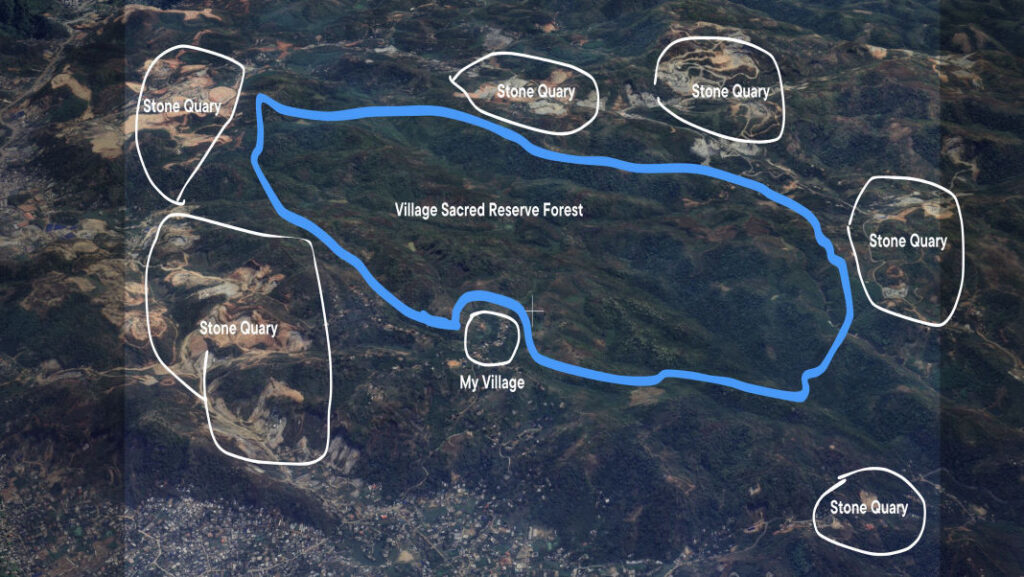
Growing up deep inside the forested Nepaldera village, secluded from the outside world yet a stone’s throw away from the bustling Guwahati city, the village has been a fertile ground for concoction and imagination and a melting pot of Garo myths and urban legends. When our forefathers settled here around 1948, just after India’s independence apparently, there were Nepali community who would rear cows here. So the village was christened Nepalduram, which later became Nepaldera. They say the Lushai or today’s Mizos would come here to hunt wild elephants. While Gaurs or wild cows could destroy the jhums, tigers growling at night would send shivers down the spine. When I was a child, I had hunted monkeys, squirrels and birds for bush meat. Along with my elder cousin, I had a hand in trapping and killing a leopard. By today’s wildlife laws, I should be straight behind bars. I agree. But in those times, wildlife was a menace and in plenty and it was acceptable to hunt them down.
By the way, much of my younger brother Dominic Sangma’s Ma’ama and Rapture were also based on the imagination and events that happened in this village and were filmed extensively here.
You would be mistaken if some of these fears and supernatural events were imagination of a scared child. The scariest manifestation of the unknown came later on in my life, very personally, just before my wedding to my ex-girlfriend now wife. Within the first two – three nights of her being in the village, she would experience twirling stomach ache right around 3 in the morning. The night before the disturbance, we had been part of a village house to house night church service and had criss-crossed a place notoriously famed as the abode of Bira. I don’t think there is a literal translation or a concept of a Bira in English but let say it’s a forest nymph or a spirit. Now Biras are apparently shape-shifting spirits, that could be a lover to a lonely wife, a pot luck of money to its worshipper or a menacingly evil devil who can do you physical harm.
At the evil hour of 3 o’clock in the morning, the scare would begin with a gush of wind ripping through the tin roof and the jujube fruits (ankil/kangkil) overhanging the roof falling like a hailstorm non-stop for no apparent reason. My wife would convulse in pain with almost unrestraint urge to get out from the room. Consistently happening for the second night, I felt wise to wake up the rest of the family members and told them of the nature of the night. Every adult member was waken up and do what every Christian is supposed to do. Pray. Sprinkled holy water, recited Hail Marys led by my two Catholic nun sisters who were at home as part of wedding preparations. The scene almost reminded of the 2018 Hollywood flick ‘The Nun’ exorcising the malevolent spirit. The worst was yet to come. On the third night, the event became so menacing but strangely the paranormal activity would cease after 3.45 in the morning. While it was good to have family members around, but I truly believe exorcising malevolent spirit is a different ritual and needs a set of special skills all together, which unfortunately my two scared sisters did not possess. Till today, I have no logical explanation and do not know how the other family members felt about it.
The paranormal is normally acceptable as normal phenomenon among the Garo society. Unfortunately, our adopted faith has somehow increasingly made us question every existence of spirits that is beyond our control. However, if you are from an era before social media like the Facebook or YouTube, it is difficult to reconcile between our age old indigenous beliefs and the Christian faith that has come to dictate our modern Garo existence.
As a child, I was told, no matter where we are, after death, the rite of passage of our soul has to traverse through the fabled mythical land of Balpakram. It really did not make any sense, because unlike now, we had never seen any image of Balpakram nor could imagine any other fabled sites that were intertwined with our indigenous beliefs. So the concept that Balpakram in Garo Hills was the final resting place for my soul did not really make sense. It was only when I entered Class Seven that I truly traveled across the Garo Hills for the very first time. I was called to attend a vocational camp at Rongkon Bosco Mount. To those from other denomination, a vocational camp is a week long initiation camp where you are selected to become a Catholic priest to be trained in a seminary.
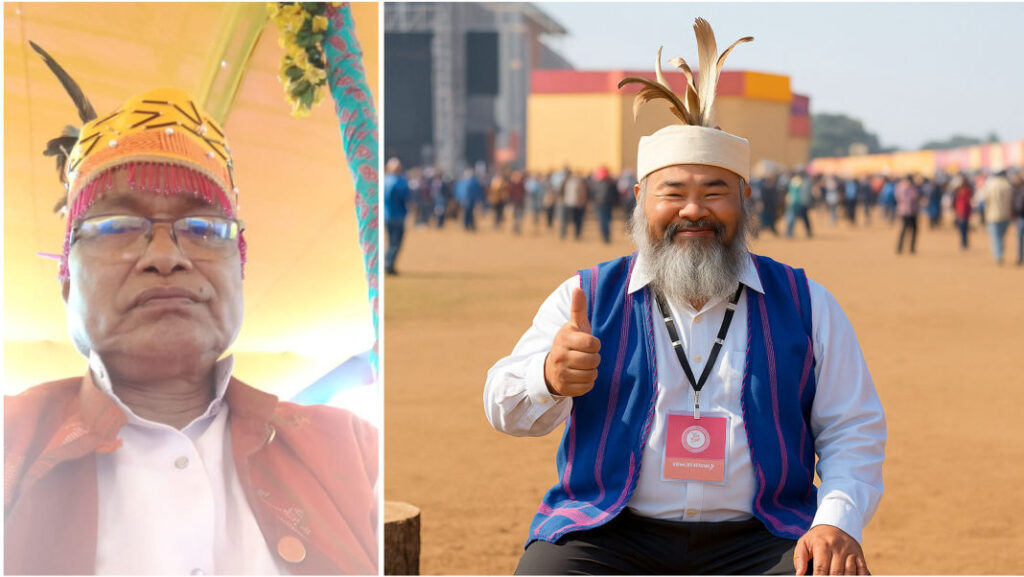
Thanks to Father Charles and Father Abong, God rest his soul, for the first time I came to discover Garo Hills, the land of our forefathers just as I was starting to explore life as a teen. I remember Father Charles and Father Abong, after the camp, drove us in Mahindra 550 Jeep or Mahindra Major, I don’t remember precisely, an enviable and only SUV of that time. From Nongphoh to Rongkon, from Rogkhon to Garobada, from Garobada to Rongjeng, from Rongjeng to Shillong. That was bit of an epic journey. I had next to nothing notion of Garo Hills but traveling through Rongjeng was like overcoming one of your greatest fears in life. Rongjeng has been notoriously painted as the magical land where people could conjure up curses and spells at will. It is believed that an expert in traditional Garo spell could pop someone’s balls into a giant balloon or just with a herb it was possible to make a beautiful woman fall in love with you so desperately. Thankfully, I was in the company of Catholic priests and I never had much time to mingle with Rongjeng girls then.
In modern Garo consciousness, I would consider Father Charles and Father Abong as some of the most influential figures that shaped Garo Hills into what it is today. We tom-tom much about present entrepreneurship and startup eco-system that we are trying to build. Father Charles, to my mind, would be the first Garo hands-on entrepreneur cum a Catholic priest – all combined into one. Father Abong’s creative energy, abundance enthusiasm for all things food and the ability to connect with people on all levels was on a different pedestal altogether. Imagine Father Abong playing the part of a hulking murdering monk in one of the plays at the Sacred Theological College in Mawlai, Shillong as a young seminarian. It was mind boggling. I have never seen a theatrical play so scary. Unfortunately, good people tend to leave the world in a hurry. I only hope his dreams in heaven are nothing earthly like ours.
Back to dreams and supernaturals. Pa Dewan Sing Rongmuthu, the pioneer of Garo writings, in his 1960 book ‘The Folk-Tales of the Garos’, elaborates how supernatural beings have powers to do both good and evil. He names 26 chief supernatural beings according to Achik beliefs. Among them are Katchi, Indik, Ahning, Sonatchi, Giting, Gaanti, Bismit, Jingjo, Chimmit, and Khasindik. Strangely, stories in the books are not something that he conjured up on his study table but are tales that were narrated by master story tellers. Unless you are a student of Garo literature, I doubt many of us are familiar with these names anymore. But by God, if any of these spirits – good or bad – knock on your door in the middle of the night, I don’t really care about the names, I know they were there.
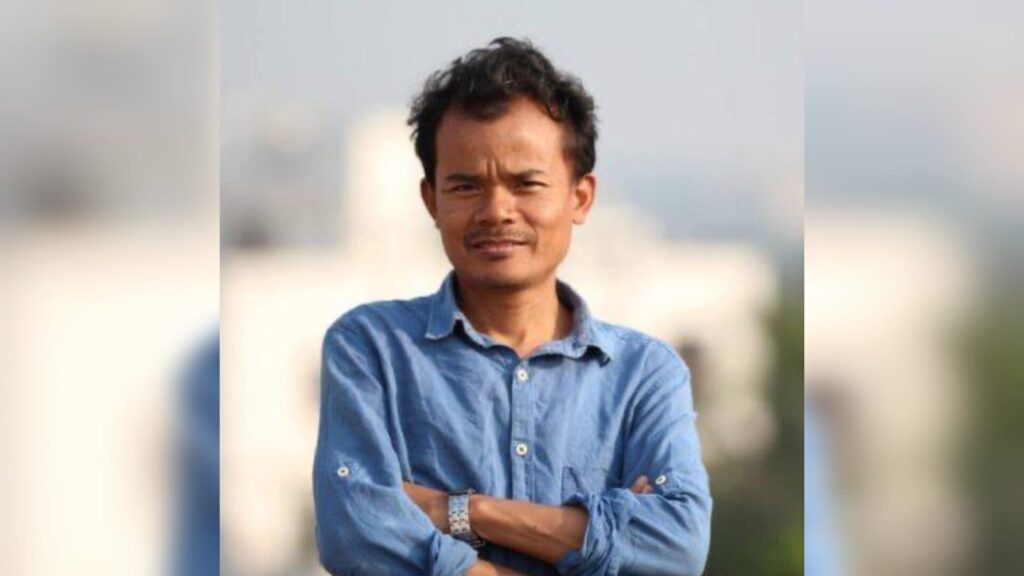
Mike Sangma is a Delhi based former journalist and media professional. He writes on various social issues and is also keen observer of economic and geopolitical issues. He is a post graduate alumni of Indian Institute of Mass Communication and holds MBA from Indian Institute of Foreign Trade.
He can be followed on
https://www.facebook.com/mike.sangma
https://www.youtube.com/@miketalkpictures605
(The views and opinions expressed in this article are solely those of the author and do not necessarily reflect or represent the views of Hub News)