


Guwahati, Oct 10: What if your daily cup of tea could one day help fuel a car or power a generator?
Scientists from the University of Science & Technology Meghalaya (USTM) have turned this idea into reality by producing bioethanol from spent tea leaves, marking a major step toward sustainable energy innovation from India’s tea-growing heartland.
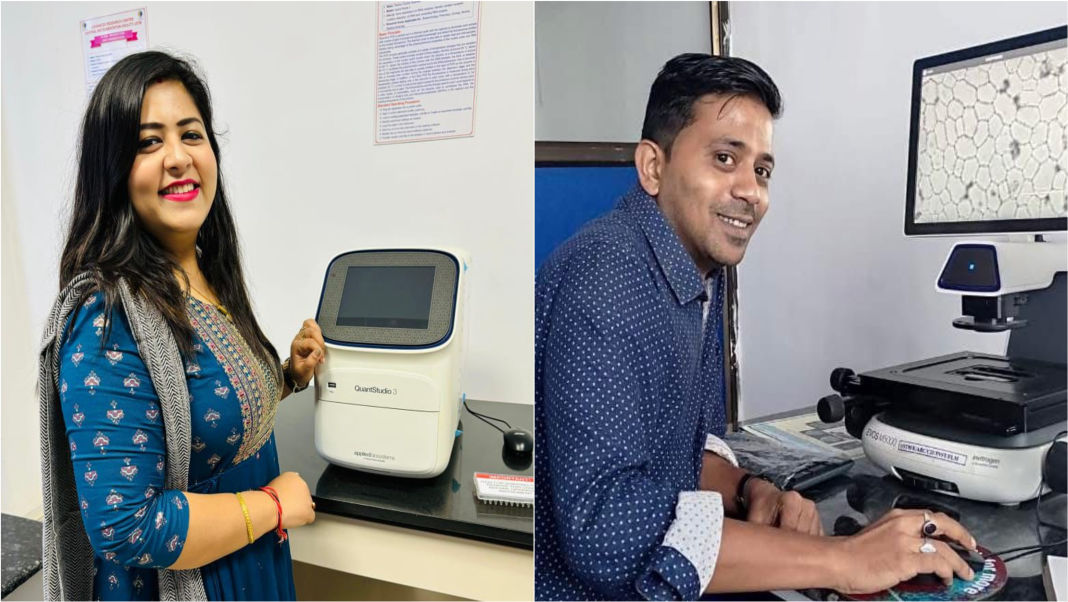
Their peer-reviewed study, recently published in Biomass Conversion and Biorefinery , reveals a pioneering technique to convert discarded Camellia sinensis leaves — the same leaves used to brew tea — into clean-burning bioethanol using iron-zinc oxide (Fe-ZnO) nanocatalysts. The research, led by Dr Shruti Sarma from the Department of Chemistry and Dr Rajib Saha from the Department of Physics, achieved a bioethanol yield of 75%, a remarkable figure for a fuel derived from household and agricultural waste. Dr. Shruti Sarma is a Senior Research Officer at USTM.
“Tea is one of the most consumed beverages in the world, and its waste is often discarded without a second thought,” said lead author Shruti Sarma. “Our study proves that something as simple as used tea leaves can be transformed into a renewable source of energy. It’s science serving sustainability.”
The research has also been featured by Harvard University.
The team used a microwave-assisted process to speed up the chemical reaction, significantly reducing energy consumption compared to conventional heating methods. In this process, oil is first extracted from dried tea waste, then reacted with methanol in the presence of the Fe-ZnO nanocatalyst — a fine material with particles as small as 30–50 nanometers. These nanoparticles enhance reaction efficiency, allowing faster conversion at lower temperatures.
Analytical techniques such as GC-MS (Gas Chromatography–Mass Spectrometry), FTIR (Fourier Transform Infrared Spectroscopy), and NMR (Nuclear Magnetic Resonance) confirmed the presence of ethanol and other desirable chemical compounds. The resulting bioethanol exhibited a calorific value of 24.01 MJ/kg, comparable to conventional biofuels, and a pour point of 4°C, making it suitable even for use in cooler climates.
According to the researchers, this method not only provides an eco-friendly fuel alternative but also tackles a growing waste problem. India produces over 1.3 billion kilograms of tea annually, generating thousands of tonnes of post-brewing waste. Converting even a fraction of this waste into bioethanol could significantly cut greenhouse gas emissions while adding economic value to what is currently discarded material.
The innovation highlights the potential of nanotechnology in bioenergy research — particularly the use of heterogeneous nanocatalysts that can be reused multiple times, reducing production costs and environmental impact.
“Using nanotechnology and microwave energy, we have created a faster, cleaner, and scalable method for bioethanol production,” said co-author Rajib Saha. “Our goal is to demonstrate that sustainable energy solutions can emerge from everyday resources like tea waste.”
Also Read: Meghalaya CM Conrad Sangma in Manipur, calls for return of popular government
Also Watch
Find latest news from every corner of Northeast India at hubnetwork.in, your online source for breaking news, video coverage.
Also, Follow us on-
Twitter-twitter.com/nemediahub
Youtube channel- www.youtube.com/@NortheastMediaHub2020
Instagram- www.instagram.com/ne_media_hub
Download our app from playstore – Northeast Media Hub