

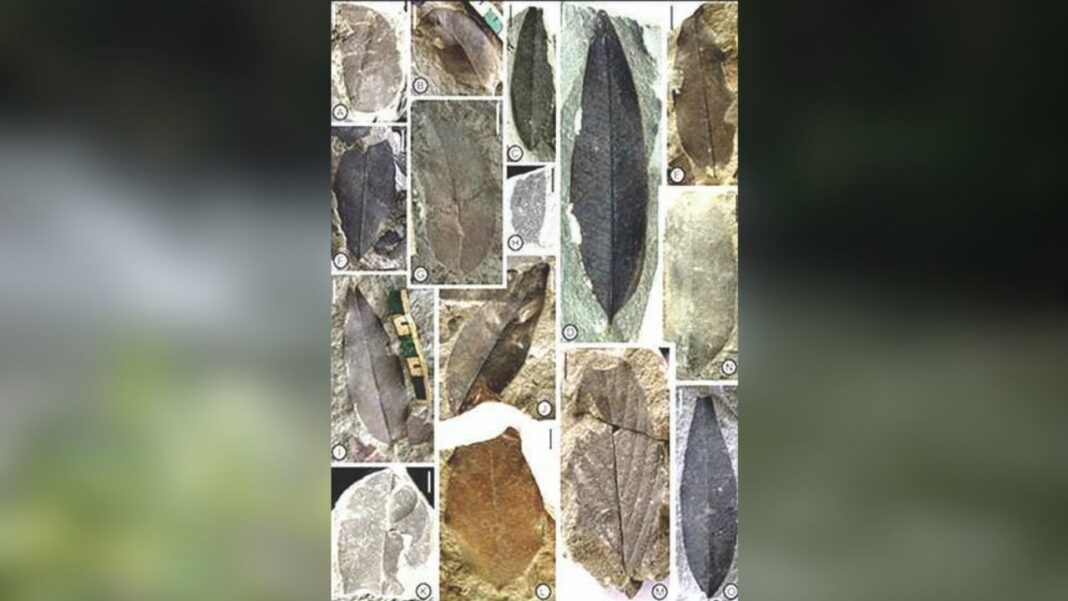

Kohima, Sept 11: Fossil leaves unearthed in Nagaland have offered rare evidence connecting the formation of Antarctic ice 34 million years ago with the early evolution of the Indian monsoon, a new study has revealed.
Researchers from the Birbal Sahni Institute of Palaeosciences, Lucknow, and the Wadia Institute of Himalayan Geology, Dehradun—both under the Department of Science and Technology—analysed well-preserved fossil leaves from the Laisong Formation in Nagaland. Their findings, published in Palaeogeography, Palaeoclimatology, Palaeoecology, suggest that the region once had a warm, wet climate that supported dense forests.
Using the CLAMP (Climate Leaf Analysis Multivariate Program) technique, scientists reconstructed ancient climates by studying fossilised leaves’ size, shape, and structure. The results showed that the timing of Antarctic glaciation drove a northward shift of the Intertropical Convergence Zone (ITCZ), intensifying rainfall over Northeast India and fostering lush vegetation.
Experts say the research not only illuminates Earth’s deep past but also carries urgent lessons for the future. With modern climate change accelerating Antarctic ice melt, similar ITCZ shifts could disrupt tropical rainfall, threatening India’s monsoon—the backbone of its agriculture, water supply, and livelihoods.
Also Read: Clashes between UPPL and BPF escalate ahead of BTC polls
Also Watch
Find latest news from every corner of Northeast India at hubnetwork.in, your online source for breaking news, video coverage.
Also, Follow us on-
Twitter-twitter.com/nemediahub
Youtube channel- www.youtube.com/@NortheastMediaHub2020
Instagram- www.instagram.com/ne_media_hub
Download our app from playstore – Northeast Media Hub