

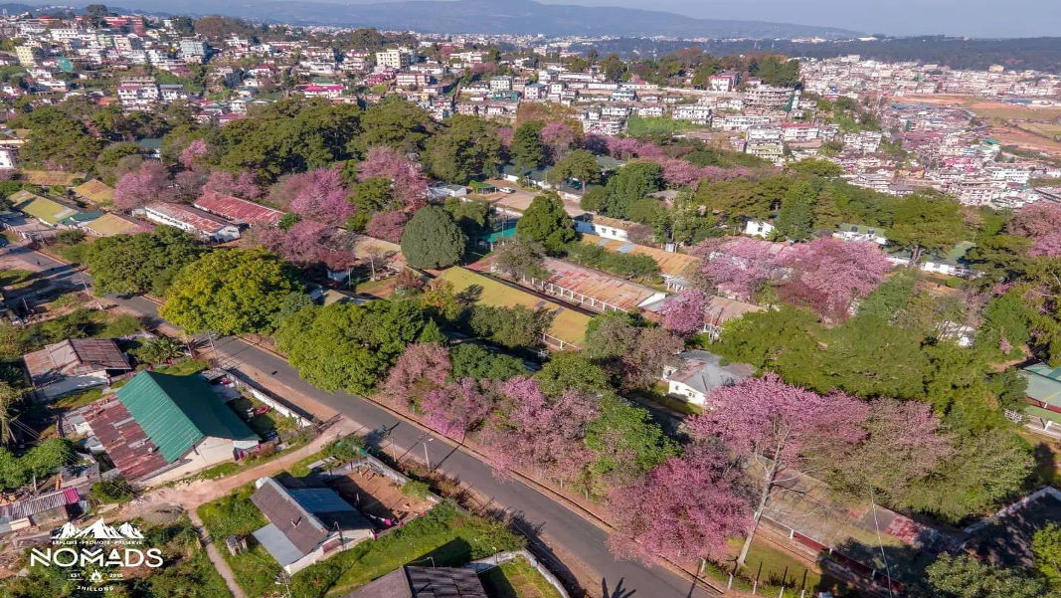

Studies explain the pigments, genetics and conservation concerns behind Meghalaya’s Himalayan cherry
Guwahati, Nov 15: As Meghalaya’s famed Cherry Blossom Festival lights up the hills with clouds of pink, two scientific studies are offering the most comprehensive understanding yet of what makes these Himalayan cherry trees bloom, how they evolved in Northeast India, and why they urgently need protection.
At the heart of Shillong’s November spectacle is Prunus cerasoides — the Himalayan cherry — a species found across the Khasi and Jaintia Hills, celebrated for its unusual winter bloom and distinctive pink flowers. Though widely photographed and adored, the tree’s biology has remained surprisingly underexplored.
Prunus L. is a genus in Rosaceae comprising of trees and shrubs such as almond, apricot, cherry, peaches, plum and nectarines. Globally, the genus Prunus comprises around 430 accepted species.

Predominantly distributed across the temperate zones of the Northern Hemisphere. Within India, 36 species have been documented as part of its native and naturalized flora. It is used as an ornamental tree and has excellent value in horticulture. The species has been used as a nectar source for bees.
Now, a new phylogenetic study by Jennifer N. Mekrini and Biseshwori Thongam in Plant Science Today has mapped the genetic relationships of cherry species across Northeast India, clarifying long-standing taxonomic confusions. The study analysed DNA from cherry trees collected across Meghalaya, Nagaland, Arunachal Pradesh, Manipur, Sikkim and even Kodaikanal.
“All newly sampled Himalayan cherry accessions cluster strongly within the Cerasus group,” the authors note, showing that Meghalaya’s cherry blossoms share a close genetic affinity with broader Asian cherry lineages, including ornamental species seen in Japan and China.
The work also identifies two major evolutionary clades in Prunus: the cherry–bird cherry–laurel group and the peach–almond–plum group — revealing how these trees diversified in the Himalayan arc.
Importantly, the study highlights high genetic variability between populations — an early indicator that Northeast India may harbour unique cherry lineages worthy of conservation.

Why do they turn pink?
The second study, published in Chemistry & Biodiversity dives deep into why Prunus cerasoides produces its distinctive pink colour — a question that fascinates both botanists and festival-goers.
The answer lies in anthocyanins, the pigments responsible for pink, red, and purple hues in flowers.
According to the review, “The phytochemical flux of P. cerasoides is dominant with phenylpropanoids, anthocyanins, carotenoids, and terpenoids.”
These pigments accumulate in petals during the cool season, which explains why Meghalaya’s cherry blossoms peak in November when temperatures dip. Anthocyanin biosynthesis is triggered by cold stress, light levels, and the tree’s internal metabolic pathways.
The review lists over 200 identified phytochemicals in P. cerasoides, including flavanones, flavones, sterols, triterpenoids and chalcones — many of which also possess medicinal properties.
Among them: Puddumin A and prunetin – antioxidants linked to anti-inflammatory and anti-adipogenic actions, Genistein – known for anticancer and anti-diabetic effects, Pinocembrin – with anti-inflammatory, antimicrobial, and neuroprotective properties and Naringenin derivatives – key intermediates in pigment production, giving the flowers their colour.

These compounds also shape the cherry’s ecological role, serving as antioxidants, pollinator attractants, and defensive chemicals.
Despite its cultural symbolism, the Himalayan cherry is listed as ‘data-deficient’ and considered endangered in parts of its range.
The phytochemistry review warns: “P. cerasoides has a low seed germination rate and slow regeneration ability due to its hard seed coat… its numbers have declined.”
Fragmented forests, urban expansion, and climate shifts pose growing threats. Ironically, the very tree that draws thousands to the Cherry Blossom Festival each year is struggling silently in the wild.
Also Read: Clay with Klae Studio brings pottery, creativity, and community together in Shillong
Also Watch
Find latest news from every corner of Northeast India at hubnetwork.in, your online source for breaking news, video coverage.
Also, Follow us on-
Twitter-twitter.com/nemediahub
Youtube channel- www.youtube.com/@NortheastMediaHub2020
Instagram- www.instagram.com/ne_media_hub
Download our app from playstore – Northeast Media Hub